Translate

Thursday, June 20, 2024

Today I said Goodbye to my Dad again, for the last time.

Today my father was buried in Poland, in the same grave as his parents.  He is back home with his Mother.  My mom fulfilled his last request by taking the trip in spite of the cost, headaches and heartaches, and physical difficulties that arise from her health.  My brother and his wife accompanied her on the journey.  It was bittersweet for me to not be there, but I am content with my decision.  I said goodbye to him at the funeral home where he was cremated, the day after he passed on.  Then I had several "visists" with him in the vicinity of his urn while he stayed with my Mom, and I even kept his urn in my house for a time.  Several years ago, when my parents were visiting us for Christmas (which was a rare event), I thanked him for bringing me to this country and for being instrumental in how my life turned out.  I wish we could've had a better relationship than we did, but I'm also relieved to finally be allowed to grieve and get closure.  

Today marks the 25th anniversary of the day he was involved in a motorcycle accident that left him with a severe traumatic brain injury.  He passed on the day before my parents' 46th wedding anniversary, and serendipitously he was buried on the anniversary of the accident that could've killed him but didn't.  We got an extra 23 years with him, albeit he was a different version of himself.

Today is also the summer solstice; the longest day and shortest night of the year.  Auspicious in my opinion.  The night is short and will soon pass.  Time is an illusion.  It is only the boundaries of the container that holds our drinking water.  With or without it, the water is still there, still able to quench our thirst.  The glass just makes it easier while we're having our human experience.

My faith is not where it's been before.  I don't believe in the literal stories associated with the organized religion of my upbringing.  I believe it's all symbolic and often serves as more of a handicap than an insight into the deep mysteries of Spirit.  Instead, I have embraced philosophical Daoism.  My Dad is no less than he was 2 years ago, no less than he was 25 years ago.  Just different, again.  We're just on different vibrational frequencies now, that's all.  

I no longer try to force things into religious interpretations.  Rather, I try to empty my mind of limiting beliefs, of ego-centric assumptions, of internalized interpretations that are not based on my own personal experience.  It's not that my Dad "went to heaven".  It's more that he never left it, and has now been reunited with Source in an unadulterated way, without the confines of a physical body, a human experience, or the limitations of time and space.   It's MY experience that I have to reconfigure, not his.  I'm the one who isn't living in reality.  I'm the one who is running on autopilot instead of being mindful of the incredible miracle that is every breath and heartbeat and moment.

I don't have to be here.  I once wasn't here, and I won't always be here.  But .... that's only true IF I identify my personal "I" with this human mind and body.  Instead, if I recognize that I am not my body or my mind, but something far greater, that I AM a mere part of a much greater whole, that I am energy, I am spirit, I am light, I am being - then I simply float in and out of "existence" via incarnations, but who knows what I'm doing in between incarnations.  Who knows what consciousness is like outside the confines of a physical brain.

Anywho, this was the first funeral for both my Mom and my brother, so in that regard, I'm glad they got the chance to participate over me.  I've been to three other funerals: my great-grandmother, my best friend, and my father-in-law.  Each was completely different, with a completely different cultural setting.  And each was clearly for the benefit of those of us left behind.  

One thing I know and I've told my children and husband - I do not have any "last wishes" regarding how my body should be handled after I die.  I prefer cremation, but outside of that, I want whatever will be most comfortable, convenient, and affordable to them at the time.  I will have already moved on from the attachments of this current life, so why continue to string my loved ones along when they can be free like me.


Friday, January 20, 2023

Giftedness in Children

When my daughter was quite young, we started to wonder if she might be gifted.  She was extremely alert as a baby, picked up all three of our spoken languages with no delays, as well as using signs we taught her.  She has always been very sensitive emotionally, and very observant.  The comments we got about her from strangers were always based on being impressed with something - but we really don't know how much of that was just our parenting style. 

We followed child-led weaning, and along with that she was introduced to regular adult food at an early age and has been eating independently even in restaurants from toddlerhood.  

We practiced elimination communication and she has been permanently out of diapers since age 18 months.

She speaks three languages and knows a lot of signs, and she is studying Latin and Tagalog in our homeschool.

She was interested in the written word early on but I did not want to push premature academics on her.  When I finally sat down to teach her to read, she picked it up in no time, and at age 9 she is now reading at about a 5th grade level.  I stopped ordering grade level readers for her after she completed the 4th grade one because I was starting to worry about the content being too advanced even if the language was fine.

My son likewise hit the ground running.  While he's much more social than his sister, he's still very sensitive and observant to his environment.  He notices things we wouldn't expect him to notice.  

In church daycare one day, when he was a little more than a year old, when we picked him up, the care taker commented how impressed she was with his talking - he was naming colors and generally interacting with her beyond what she expected.

He, too, speaks three languages with some signs.  He listens in to his older sister's Latin lessons and often picks things up without being taught.

He insisted on learning to read at age 5, and in less than a year he was reading at a first grade level.

Just the other day he made a mental connection we hadn't been expecting.  We were watching The Parenting Test, a show assessing different parenting styles.  One of the styles features was "free range".  He commented that he thought probably free range parents must be either sanguine or phlegmatic in temperament.  (We had taken a temperament assessment several months ago and he really latched on to everyone's temperaments.)  Did I mention he is 6 years old?

All this to say - so what?  Does this prove they are gifted?  Or are they just very bright, and sadly, most of their peers are not being challenged enough and so the disparity between them looks bigger than it is as far as potential is concerned?

Most Americans make multilingualism seem like a miracle almost.  We know around the world this is no big deal.  Most Americans are married to the diaper industry and fight their toddlers during "toilet training", while the majority of the world simply cannot afford 3 plus years of diapers and cloth gets old real quick, so they're motivated to get their kids toilet independence much sooner.  Most Americans send their children to public school, where - let's be honest - the curriculum is anything but academically rigorous, and everyone is put into cookie cutter age-based grades without the sort of one-on-one attention homeschooling affords that allows each child to develop at their unique speed.

So it is quite possible that our children are not gifted in the measurable sense of the word but merely have a lot of benefits that their peers do not that are allowing them to succeed in learning.

What would change for us if we got an unbiased third party to tell us that, indeed, there's more to it than that?  

I think I would push a little more.  Give a little more challenging work.  Be a little more intentional.

But that also comes with certain risks.  I could turn them off from a love of learning.  It could lead to burn out for all involved.  I could prioritize academics over more important things, like mental health or character development.

What if we simply proceed as if they really are gifted?  Why not challenge them as-is?  Why not gently push until there is a steady resistance?  Why not keep a balanced outlook in mind and just proceed right away?

Monday, June 6, 2022

Am I Christian?

The first problem is with labeling.  What makes a Christian?  There are definitely disagreements among self-proclaimed Christians about what makes a Christian.  Many fundamentalist evangelical protestants don't consider their ancestors in faith - Catholics and Orthodox, to be Christian.  Rather, they are blinded by the rituals and see pagan practices instead of an embodiment of a Christian lifestyle.  Protestants and Catholics and Orthodox all often disagree that Mormons or Jehova's Witnesses are Christians, while the latter do consider themselves as such.

Given this is what I have to work with, the only thing I can think of is that a Christian is someone for whose spiritual life the person of Jesus figures prominently, more so than any other.  Therefore, Bahai, Muslims, and Unitarian Universalists aren't Christian even though they all have a place for Jesus in their world-view because that place is not one of centrality and prominence.  

And here's my own dilemma.  I have gotten too wrapped up in the externals too frequently to really know if it's the person of Jesus or the traditions that happen to be associated with Jesus are what tickles my spiritual fancy.

I can't say with all honesty that I am somehow convicted that I must follow Jesus as He is portrayed in the Gospels.  I believe it is one valid way to lead a meaningful life, and I often wish that were enough for me, but I guess I just get wrapped up in the externals and lose sight of Jesus altogether.

Protestantism is out for me, as there isn't much of anything to get wrapped up in - you either have a relationship with Jesus or you don't.  By that standard, I don't.  

But just because I could live out the appearances of a decent Christian in the Catholic or Orthodox context doesn't make me any more of a Christian.  I still don't have a relationship with Jesus.  It's just easier to hide bc there's things that I can be doing that sort of distract me from that non-existent relationship.

Orthodox and Catholics would say that these practices are tools, ways for me to draw closer to God and thereby form and strengthen that relationship with God.  And I believe that, but it just doesn't seem to work for me.

I've had times in my life where I felt God's presence, but rarely was it specifically Jesus.  Except in Eucharistic Adoration, but that's because it's made pretty clear what we're looking at - the Eucharistic body of Jesus.  But then I consider the Orthodox understanding of the Real Presence and I have to agree - but, but.... you're supposed to *eat* it, not stare at it as it's held hostage in an ornate golden box!

So why not just sample here and there, as I've been doing?  Why do I keep feeling the need to identify myself with one group officially?  I want to belong.  But I don't want to do what it takes to belong, namely: conform.  I can fake it, sure.  But my integrity is important to me.  I was born into Catholicism.  I am no more a hypocrite here than any other Catholic struggling with their faith in some aspect.  I have a birthright to Catholicism.  That gives me some solace, knowing that God will meet me where I am.

But Orthodoxy would need to be a choice I make.  A conscious, intentional choice made as an adult, fully aware of what it is I am signing up for.  And I'll either need to actually believe it, or pretend to believe it.  I do not actually believe it, and I cannot fake it.  

And so I suffer alone and in silence.  

Monday, May 16, 2022

Why Not Unschooling?

Lately I've been wondering if I may not be heading in the direction of unschooling as our approach to home educating our kids.  The short answer is no.

Two reasons.  One, I keep hearing how unschoolers "trust" their children.  I don't think trust is a relevant term.  How can you trust someone to do something if they've never been exposed to it?  How can you trust someone to do the right thing if they've never been taught right from wrong?  How can you trust someone to know what to do without being explicitly directed?  This last one is particularly pertinent to me as an autistic woman who flew under the radar for over four decades.  There are many "common sense" things I only learned when they were explicitly explained to me, usually by my husband!  So I know first hand that not everything that comes naturally to one person will be natural to another.  I trust my children with the things they have already shown themselves to be trustworthy in.  That's the other thing.  I don't automatically trust people until they have shown me they are trustworthy.  Trust is earned.  I expect to have had my children "earn" my trust in their self-directed education by the time they are somewhere in their teens, but not before.  How do they know what they don't know?  How do they know what there is to know?  Of course, I can't teach them everything, nor do I want to.  But having more life experience than them, I at least know what sort of things have come in handy for me and why, and therefore which things I want to equip them with for the future.  

The second reason I won't be unschooling is because this is a join venture.  We are learning together.  Some things, they bring to the table and we all learn together.  Other things I bring to the table, and again, we all learn together.  I do not fill our days with busy work.  I do not insist on things because that's what the public schools are doing.  In the words of Charlotte Mason, I try to create a certain atmosphere where certain subject matter is a daily topic of conversation, and I try to instill a certain discipline in doing things because they have been set before us as being important by someone we love.  I think it is not the right attitude to raise a child to believe that they never have to bow to authority, that they are the master/mistress of their own life, because this is not always possible nor even healthy.  Of course, I want my kids to shoot for the stars, but not without proper safety equipment in place first!  Certain knowledge and skill sets are simply universally foundational in our society.  There is no question, for instance, that to be successful (productive/content/healthy) adults, they will need to not only have basic English literacy and numeracy down, but also cultural literacy (history, geography, social sciences, foreign languages, the arts), basic understanding of the physical world around them (sciences), and critical thinking skills to offset the incessant gaslighting present in mass media that passes as "news".  

The exact content for any of these may be up for debate, but the importance of some level of all of these "subjects" is beyond contestation for me.  And the idea that my kids should have to wait until the situation arises in order to be intrinsically motivated to then finally learn the pertinent information or skills seems like a major waste of time and procrastination of the inevitable.  Instead, when faced with the situation at hand, they ought to be able to hit the ground running, already knowing what to do for the best outcome.

I don't think higher level math or science is necessary unless one is going into a field that requires it.  But arithmetic and basic algebra is something we use as part of our financial literacy such as budgeting, and in meal-planning and cooking - at the very least.  

I don't think an in-depth understanding of the intricacies of chemistry or physics is necessary for everyone, but understanding the basics of weather patterns, seasons, how these affect the availability of food, what happens to waste, the environmental impact of our consumer choices - these are all things that matter.

I don't think everyone needs to be a lyricist or public speaker or poet, but let's be honest.  People judge us based on how we express ourselves both orally and in writing.  Misspellings and bad grammar may not necessarily translate to lack of know-how on a given subject, but they will look bad and cost us our credibility.

I could go on but I won't.  The bottom line is, taking the relaxed, eclectic Charlotte Mason-inspired approach to our home education, my children spend 2-3 hours a day on content prepared by me, and the rest of their waking hours (so about 11 hours!) pursuing their passions, getting lost in their own pursuits, following rabbit trails, perfecting the skills they find most interesting, inquiring about information they find most appealing, doing whatever their hearts desire.  Letting go of those 2-3 daily hours of prepared content will not help my children suddenly have the amount of time they need to self-educate... they already do that!  They do that on the weekends, during breaks, in the evenings, and they don't realize they are still learning even though we don't officially call it "homeschooling".  

In a word, we won't be unschooling because we don't have to.  We already have the perfect set up with the right balance of prepared content and freedom to cover all of our bases.


Friday, May 13, 2022

Am I religious?

What does it mean to be religious?  I used to be both, religious and spiritual.  Specifically, I was "a believer".  I believed in the standard interpretation of my faith tradition.  I identified so closely with my religion, that I didn't appreciate the cultural aspect of religion and simply associated religion with "truth".  So when I started to doubt the literal "truth" of my religion, I embarked on a decades-long spiritual journey to find a different religion that could take the place of my previous world-view.  Never in over 20+ years did it occur to me that maybe none of the world religions have the full, literal truth of reality.  I simply assumed that one of them must, and if it isn't mine, it must be a different one, and once I found it, I would convert, so that I could see the world through the lense of truth again.

Even after having gotten a pretty decent understanding of many different faith traditions and finding some fault with every single one of them, I could not allow to rise to the surface what was already brewing deep within: none of the religions have the literal truth because that isn't the purpose of religion.  Religion is an aspect of culture, meant to help people find their place in the world.  It teaches us how to get along with each other, how to overcome difficulties, how to live meaningful lives, and eases the trauma of transitioning from this life to eternity - both for those approaching death and those left behind.

In fact, religion is quite useful and can be a very positive force in a person's life... unless it is interpreted literally and God is taken hostage and kept far away from all nuances of understanding and meaning. Then it is no different than any other cult, just much more socially acceptable and widely practiced.

When I was diagnosed with Autism Spectrum Disorder, I was handed a symbolic new set of lenses through which to see the world.  I was given the gift of self-understanding.  My incessant need to label things in order to understand them finally helped me look back on my life and appreciate why I had been unable to find "the religion of truth."  The name of the game was: nuance!

As I began to slowly recognize that nothing in life was strictly black or white, whether I wanted it to be or not, I began to apply this same logic to my faith tradition.  I finally accepted that there was nothing to run away from and nothing to run to.  I would have no choice but to form my own personal belief system based on what I have learned from all the different faith traditions, from personal experience, and from science and logic.  

After a brief time of mourning, I started to think about how I could reintroduce the religion of my upbringing into my adult life in a meaningful way.  I hadn't technically left the church - not since coming back the second time some years ago.  Not physically, anyway.  But mentally and emotionally, I had checked out.  

I was Catholic through and through.  I was familiar with the liturgy of the Mass, even if it's changed a lot since my childhood (not even counting the change in language).  I was comfortable with a lot of the messages that come to me from the art, music, ritual, and Bible stories.  And if life is about nuance, then I can take the good with the bad... or rather, I can take the good and leave the bad.  I don't have to allow the bad things to totally ruin the good.  I can simply learn to ignore the things that are illogical, immoral (ironic, I know), or just irrelevant to my life.

And circling back to the need to label... how do I label myself now?  Am I religious?  My knee-jerk reaction was that yes, in spite of no longer believing in the basic Christian theology, by virtue of being appreciative of Catholic ritual, I was still religious.  But lately, I've wondered if that's not misleading.  Generally people use "religious" and "believer" as if they were interchangeable.  They are not.  I am not both, religious and a believer.  I am just religious.  But my religiosity does not mean that I follow the dictates of my religion, well, religiously.  And that's because my religion is a part of my culture.  I have freedom in only adopting those parts of my culture/religion that actually bring me closer to God and being a better person.  Those are the very point of religion, if you ask me.

And so I'm spiritual, religious, but not a believer.  Of course, that last term is a misnomer as well.  I believe in plenty of things, even spiritual realities that haven't been (or cannot be) proven by science.  I just form my own opinions and beliefs now, instead of simply regurgitating what has been passed down as unquestionable tradition.  

Wednesday, May 11, 2022

Autism Accomodations

I have never had formal accommodations.  Not in school, not at work, not ever.  I was diagnosed just last fall, the day after my 43rd birthday.  And only now I can see that I've been getting accommodations all my life without even realizing it.  My life is THAT charmed.  I never even had to ask for it, but now that I know what to look for, I see how my life has always been filtered through someone's assistance.  First, it was my parents, who sheltered me and kept my childhood near idylic.  The only small problem was that, unaware of my autism, they didn't realize I'd need to be intentionally taught basic things about getting along in life, such as meal planning and cooking, and that I did not automatically understand the nuances of life.  Instead, once I heard a statement and took it to be true, it was 100% unequivocally true for all time.  I didn't realize it may change with time or circumstances, or that it may only be partially true.  So I ran into many instances of confusion and frankly, like life was gaslighting me.  

At age 19, after getting my Associate's Degree while still living at home, I joined the Army.  It, too, came with its own accommodations.  I was told where to be when, what to wear, what to do, when and what to eat (without having to cook or plan any of it) etc. While very stifling for some, it eliminated the need for my autistic brain to struggle with decision fatigue.  I didn't enjoy the poor morale, though, and as fate would have it, my father's accident and resulting traumatic brain injury gave me an early out of my military commitment.  

But by the grace of God, though, by this time I had met my now-husband, who followed me to my home state and with whom I lived after getting out of the Army.  And it is he who has filtered life for me ever since.

I have never lived on my own.  I have never had to juggle work and bills and school and parenting and whatever else people consider non-negotiables.  I've been cruising and unaware of it.

Thanks to my autism diagnosis, I've been reflecting on how I've gotten this far in life without any accommodations.  I was diagnosed with "level 1" autism, which already would imply I should be able to get along better than others on the spectrum.  But even so.  I have a graduate degree.  I served in the military.  I speak multiple languages.  I held down several long-term jobs.  I had two home births and I homeschool my children.  All things that seem like accomplishments for many people, especially those who wouldn't personally see themselves doing some of these things.

But see, I have had unofficial accommodations all along.  That's why I've been able to do what I have done.  I have had a support system, if even in only one or two people.  I have had people who accepted me as I am, appreciated me for what I did bring to the table, and didn't fault me for what I didn't.  I have experienced unconditional love since day one.

No wonder neither I nor anyone else ever thought I could have autism.  And yet, finding out has been one of the best things to have happened to me.  Because now I don't feel guilty for the shortcomings that have led me to depend on my "accommodations". 

Sunday, May 1, 2022

When I Stopped Being Christian

I had been on a decades-long search for "Truth" (with a capital "T"), reading and researching all major (and several minor) world religions.  I've been able to find some truth everywhere I turned, making it increasingly more difficult to choose "the one right path".  I refused to acknowledge that there was no such thing. 

I finally turned to Eastern Orthodox Christianity.  I found a beautiful little church where I periodically attend Saturday vespers, where I stand in the presence of the Divine, surrounded by reminders of the holy, transported to a timeless place by the candlelight and chanting.  I met Father Joshua here, a very approachable priest who is a husband and father of 9!  I started taking Intro to Orthodoxy classes with him and a very small group of other inquirers, most already having committed to conversion.  

I enjoyed these sessions very much.  But what became undeniable thanks to them is that there was an entire ocean of disconnect between what Orthodoxy - and in fact, Christianity in general - teaches and what I actually believe in my heart of hearts.  I so wanted Orthodoxy to be the answer to my prayers.  In a way, it was, but not in the way I expected.  Orthodoxy was like a living history experience, helping me feel closer to the earlier Christians.  As I became convinced that Orthodoxy is probably one of the closest interpretations of Christianity that there is, I likewise became convinced that I could pretend no longer to believe that the Christian myths and legends were literally true.

Actually, depending on whom you ask, you'll learn that literal interpretation is actually besides the point, or at least it can be.  And it is this new understanding that is allowing me to start reconstructing my place within the Christian mythos.  For a long time now, I've said that I find the symbolic understanding of various Christian teachings to be much more relevant and meaningful to me than the literal explanations, but since the symbolic is only ever given any airway as a layer upon the assumed literal, it's hard to have one without the other among other Christians.  

If a Christian is a follower of Christ, and if Christ is the Logos, the Way and the Truth and the Life, then Christ is the Western embodiment of the Tao, and then I can call myself a Christian.  But really, it would be more accurate and less cumbersome to just say I am a cultivator of the Tao (however imperfectly I stumble with that).  Maybe personifying all manner of divine energies does more harm than good, at least for my sense of ... rightness.  My sense of familiarity and comfort is absolutely very much still within the Catholic-Orthodox liturgical church life.  The rituals are meaningful.  The ornamentation is beautiful.  The music can be uplifting (it pretty much is guaranteed to be in the Orthodox church - with the Catholic church, it's hit or miss.)  

But alas, I cannot yoke myself fully to this religious identity, because with it come certain expectations and limitations that I do not find helpful nor necessary.  For this reason, I'm unable to convert to Orthodoxy, as this would be hypocrisy.  But I am able to periodically bask in Orthodoxy's divine beauty as a visitor (thank God they welcome visitors!), while remaining Catholic.  You see, I can't shake being Catholic even if I wanted to.  The Catholic church doesn't seem to care much if I actually believe what it teaches.  It just wants to count me among its adherents.  And since the feeling is sort of mutual, it's a win-win for me.  Contrary to what I used to think, I'm not being a hypocrite if I participate in Catholic ritual with reservations, because there is an overwhelming sense of "God meets you where you are", and this is where I am, so I keep bringing myself as-is to God, and whatever God deems appropriate, God will do regarding my faith journey.  

What I need to do is completely let go of any sense of external validation from fellow Catholics/Christians/believers.  It is not for them that I remain a Catholic.  It is to nourish that of God that resides within me.  I do it for me and I do it for God.  And if ever God decides to lead me elsewhere, I hope I will be strongly tethered at that point to God-the-Truth and not merely God-the-Interpretation, to follow the path laid out in front of me.

Monday, March 28, 2022

God's Magical Dust book

 A flashback to my first book from 2015, God's Magical Dust. I wrote and illustrated this bilingual Spanish-English children's book shortly after my daughter was born.  I wanted there to be a book about donor conception that was available in Spanish, and also one that incorporated Bible verses for support.  Among Catholic theologians, there is some controversy as to if embryo adoption is a valid form of adoption, and the topic of donor conception is rejected carte blanche.  I poured over the reasoning behind the RCC's stance on artificial reproductive technology, and while I agree on the part about creating "excess" embryos that are then just thrown out or donated to science (or even worse, aborted after multiple embryo transfers prove to be more successful than hoped for), that is where my agreement ends.  

I agree that sex belongs in the safety and sacredness of marriage between two consenting adults (the details there also differ between me and the RCC, since I do not think the gender of the spouses matters).  However, I do not believe that sex is some sort of super-natural way of the couple becoming more like God, in that literally "two become one" when natural conception goes according to plan.  

My husband and I grew much closer in our relationship with each other not because we got lucky and conceived without effort, but because we had to work hard and long and make sacrifices and have many heart-to-heart conversations that drew us closer as we decided how to proceed on our journey towards parenthood.  The fact that our "unitive act" didn't directly lead to the conception of our children is a non-issue for us.  We are closer as a result of not only our joint experience of infertility, but also because of the various manners in which we tried to resolve it.

That said, I disagree that IVF (in vitro fertilization) or IUI (intra-uterine insemination) are in any way inherently evil.  Most especially if the gametes of the two spouses are used.

When it comes to donor gametes, this becomes much more convoluted.  Personally, for us, we could not get on board with bringing a "third parent" into our family.  However, because we know life begins at conception, embryo adoption was just that - adoption.  So we were bringing not a "third parent" but a whole other family, the genetic family, into our family, in a way.  For us, we couldn't get past seeing the use of donor egg or donor sperm as different from "having a baby with someone other than my spouse", even if sex was not a part of the equation.

But I had to allow for the possibility that other couples may see things differently.  Other couples may very well be able to look past that, precisely because there is no hanky panky going on.  And for those couples, I would hate to impose my own person comfort level, if it meant the difference between having a baby or not.  Embryo adoption is not feasible for everyone, and it is not available everywhere.  Egg and sperm donation is much more common and sperm donation in particular is a lot more affordable than embryo donation for the recipients.

Ultimately, when we decided to pursue embryo adoption to start our family, it was done with a ton of spiritual research and reflection.  The end result was the birth of this book, God's Magical Dust.  Because really, what else are human gametes if not "God's magical dust"?  After all, in the Bible it says that from dust we come....

The book is rather two books in one.  The first half is in English, and the second half is a repeat of the first, but in Spanish.  This was mainly so as not to take away from the illustrations by excessive text.  But also, there was a page minimum to publishing the book ;)

I hope you enjoy God's Magical Dust and feel free to share your thoughts!

Sunday, July 25, 2021

Parental Rights vs Trans Kids Rights?

Most reasonable people would agree that everyone in a free society should have the right to do whatever they want to do unless and until that right starts to interfere with the rights of others.  When there is such a conflict, which is often the case, it is important to put one's personal opinions aside in the interest of figuring out what is the greatest good.

The reason people do not have certain rights and responsibilities until they are 18 years old is because that is the age we as a society have determined to be the time when a person can reasonably be expected to know enough about the world to make decisions with full understanding of their implications.  

This is the reason that we have to wait until we are 18 to vote, get married, pay taxes, buy cigarettes... even older to rent a car or hotel room or run for office or buy booze.  Some decisions have been granted to slightly younger people - generally 17 year olds can enlist in the military and see an R rated movie, while 16 year olds can drive unaccompanied and apply to be emancipated from their parents if they can establish due cause.  There is obviously some wiggle room in the later teen years, as maturity levels vary widely between individuals, and we all know some 40 year olds that you would not trust babysitting your kids or house sitting for you.  But there are certain age restrictions nonetheless because what would the vote of a five year old really mean?  That they have mastered the art of eeney-meeney-miney-mo?

When it comes to issues of sexuality, things start to get a little dicey, as is the case among adults as well.  An 18 year old can be arrested for "statuory rape" of their 17 year old partner if the minor's parents have it out for them, even though the age of consent for sex is 16 in many places.  It can't be that the water in one state makes for more mature 16 year olds than in others.  So the age restrictions do seem to be rather abstract.  But the point is that all 50 US states have a minimum age of 16 for consent to sex, which means across the nation, no one agrees that teens younger than 16 are generally mature enough to understand the full reprecussions of sexual intimacy and the potential fallout, both physical and emotional of engaging in what many (myself included) believe is an activity best suited for adults married to each other.  But that's a digression.

Interestingly, we already see a disconnect between the laws on the books about minium age of consent and the age at which an adolescent can get an abortion without their parents' consent or knowledge.  If the teenager is of the age of consent in their state, then they must by extension be considered old enough to handle the ramifications of that decision, including an unintended pregnancy.  For instance, the state of Oregon does not grant minors under the age of 18 consent to sex, yet neither does it require parental consent or notification either.  This is a mixed message.  On the one hand, the state is saying that a 16 or 17 year old is not old enough to enter into a sexual relationship, yet that same state is saying that if they do anyway, they can then proceed to decide if an abortion would be the best course of action should they get pregnant.  Isn't the former much less involved than the latter?  Many people do regret their abortions, not to mention the invasiveness and potential complications from an abortion.  Shouldn't they be accompanied by their parents when making such a life-changing decision?

So already we see that the idea that 18 is a magical age at which a child becomes an adult is wrong.  There is no such magic moment.  It is a very nuanced situation.  And you know who can best help determine when a child is ready for the responsibility?  Their parents.  Not the government, and not the child themself. 

If a child or tween cannot consent to sex, how can they consent to anything else having to do with sexuality and gender?  How can they realistically grasp the ramifications of undergoing irreversible therapies such as hormones or surgery when they haven't lived long enough to get that they can't just click undo and go back if they change their minds?  And I think it goes without saying that adolesence is a time of self-discovery, when teens try on different identities in order to figure out which is the best fit for them.  To insist on the minor committing to the first identity they try on in the name of "allyship" is terribly misguided.

I of course have in mind here the idea that when a child expresses that they feel they are of a different gender than has been affiliated with their sex, we are seeing the government stepping in to interfere with how the child's parents choose to handle this ubiquitous growing phase.  That is not to say that children cannot know that they were born "in the wrong body".  But it is simply too soon to know for certain which children will stick with this identity realization, and which will try it on for a while and then move on to something different.  

For this reason, I support the idea of letting a child try on different genders so long as they do not require any permanent ramifications.  They can change their outfits, their hair, their name, their pronoun... all things that, should this turn out to be a phase, can be changed back.  And even if it is not a phase, and the child does end up not identifying with the gender associated with their sex, if we believe that gender is a spectrum, how do we know that the child may not grow up to identify as nonbinary, and any intentional, invasive treatments did more harm than good if they only forced the person to present more of a different gender, but still of a binary gender nonetheless?  

There is no reason to jump to life-long changes when a child expresses a desire to transition.  We can support them without making them responsible for decisions they are simply too young and immature to make on their own.  This is too great of a burden and it is irresponsible parenting to rush the process, and even more irresponsible governing to interfere in what should remain between the child and their parent.

What I know the retort to all of this is, is that "not everyone has the benefit of having compassionate, understanding parents".  I totally get this and sympathise, but what does that say about the state of our society that we presume that parents are not doing their job and therefore the child is better off with the state than with the very people whose role is to protect them and provide for them and prepare them for adulthood?

If we start bypassing parents, we might as well keep lowering the age of majority, until parenting is a mere 5 year stint that ends when the parents drop off their child at mandatory kindergarten, to be educated, indoctrinated, and essentially raised by the state.  


Saturday, July 24, 2021

A Case for the use of "They" as a Universal Third Person Singular Pronoun

I have been erroneaously called by my husband's surname before.  This is a social convention that many people in the West are still accustomed to as being the norm.  The assumption is that when a woman gets married, she changes her name to that of her husband.  I did not. And I often got quite upset about being "misnamed", that people didn't bother to actually ask for my name, that their calling me by my husband's surname must mean they also are making other assumptions about who I am.  I was an angry feminist during this time.  I had little patience with people, extended no grace to them.  Rather, I took it personally and accused them of being sexist. But women taking their husband's surname was a common enough practice that most people simply don't think to question it until it gets pointed out to them.  After it gets pointed out a certain number of times, people slowly start to realize that things actually are not as they assumed them to be, or they're slowly changing and aren't as they used to be.  Then they adjust and instead of assuming, start asking before using a married woman's surname.  

We are now in such a time where more people are starting to realize that gender is the new version of this phenomenon.  Most of us have long assumed that there are two genders, based on the two biological sexes, and so we refer to people accordingly.  We do not mean to offend.  Many of us literally cannot comprehend a world in which there is such a thing as a gender spectrum.  Many people's first knee jerk reaction is to simply resist change and hold on to whatever is familiar at all costs. But as we get more and more exposure to the idea that some people transition from one gender to another, some don't believe either gender resonates with them, and some feel comfortable with both simultaneously, we, too, will slowly start to realize that there's a gender spectrum, rather than just assuming a person that looks a certain way must be one of two genders.  (Just like we used to assume that a woman must either have the surname of her father or her husband.)  Change to something as fundamental as gender, much like naming traditions, will take time.

Rather than getting angry, it behooves us to remember where we are in the scope of things.  We have to know whether our preferences are mainstream or not.  And if they are not, then it is our job to educate others, yes even tirelessly at times, about those preferences.  Because it will take time.  No amount of name-calling or cancelling of people for not being "woke" to the newest practices is going to help.  Rather, it's only going to force people to push back and get defensive about their position.  Most people are not trying to be intentionally hurtful towards others.  This doesn't mean that we should excuse hurtful behavior, but it also doesn't mean that we should fail to do our part to bring about change.  Change happens slowly, and it is more forthcoming when people feel safe to explore new ideas without fear of judgment or ridicule.

For instance, I do not understand the idea of nonbinary gender.  I understand "switching sides", I undersand non-conforming behaviors that resist gendered stereotypes, but I am struggling to appreciate the idea that some people simply do not have an attachment to either of the traditionally recognized genders.  Specifically, what I'm at a loss as to the changes taking place in how we talk about nonbinary people in the third person singular.

A living language can, does, and pretty much must change over time.  I also understand that different languages have different experiences with gendered language, and so they will have more or less problems adjusting to gender-neutral markers.  I have fought the use of "mankind" and the "universal he" to refer to humanity and unknown humans for decades.  I hate the practice of slapping a "Mrs." in front of a married man's first and last name to refer to his wife.  I actually found it perfectly acceptable to write "she/he" in academic papers in order to stay grammatical while also avoiding sexist assumptions (a practice that in recent years has gone by the wayside in favor of the "singular they", due to the alleged cumbersome nature of the latter).  But non-gendered third person singular pronouns are an entirely new can of worms for me.

I understand how a human being that does not identify with female nor male would resist using either of the gendered pronouns (she/he).  I undersand how said individual would nonetheless take offense at using the gender-neutral third person pronoun "it", as this connotes inanimate objects or perhaps animals in modern English (although there was a time when children were often referred to as "it").  I understand that a non-binary person may want to use "they" in place of "she" or "he", and in fact there is a precedent to do so in written English when talking about a person whose gender is unknown.  It is certainly more tricky to do so when referring to a known individual, because we are used to assuming that once we know a person, we can easily place them into one of two neat categories: she or he.  With time, this weirdness will pass.  

What I don't understand is the idea that different non-binary individuals get to "pick" made-up letter combinations, call them "their pronouns", and expect the rest of us to suddenly start using them as if they're words that are part of our everyday lexicon.  Xe, Co, Ze... these are not words anyone outside the trans community ever comes accross.  And if we're going to have a new word, which of course is perfectly acceptable, albeit awkward in the beginning, there needs to be a consensus, or the words must be interchangeable.  Otherwise, if Xe, Co, and Ze all refer to a non-binary individual in the third person, what distinguishes them from each other?  Are they not identical in meaning?  And if so, what is the point of having multiple words tasked with the exact same role in language?  This is highly inefficient.  Perhaps in other languages, the nuances might be ironed out.  In Spanish, for instance, there is a formal and an informal way to refer to the person you are addressing: "tu" or "usted".  Technically, they perform the same role, but the nuance of familiarity or politeness distinguishes them.  In English, we no longer utilize "thee" and "thou"; we only use "you".  So if the second person singular only has one word, and the third person singular already has three ("she", "he", and "it"), then adding not one but several more to the category is simply nonsensical.  

What makes more sense, actually, based on the history of the English language, is to collapse the third person singular pronouns that we are all already used to, rather than inventing additional ones.  People simply stopped using "thee" and "thou" because they were already comfortable using "you".  What if the same thing were to happen to the third person pronoun?  Instead of using "she" and "he" and "it", we could slowly start using "it" to refer to all people in the singular.  But this is actually not likely since, as mentioned above, there is a nuance between "she/he" and "it" in that only the first two are associated with human beings.  

Perhaps then, we can take our pointers from the second person pronoun again.  In English, we do not care if we are addressing one person or an entire group; we say "you".  Why couldn't we do the same when discussing people not present?  Whether the group is mixed sex or all same sex, we simply say "they" and no one blinks an eye.  What if we take the same "they" and tack onto it the singularity of the third person, just like we did with the singularity of the second person?  So now, everyone in the third person, singular or plural, female or male or otherwise, would all be referred to as "they".  And perhaps we keep "it" to differentiate inanimate objects in the third person singular, though they are already "they" in the plural, so maybe that would eventually go away as well.  In fact, in American Sign Language, the three pronouns are already the same sign; you simply point to the side and from the context of the conversation, you know if the sign means "she", "he", or "it".

Using "they" the way we use "you" would follow the precedent of the history of the English language, it would do away with distinguishing between genders within the pronouns used, it would utilize a word every English speaker is already familiar with, and it would honor those who do not identify with female or male genders exclusively.  Sounds like a win all the way around to me.

Friday, July 16, 2021

Modesty and Body Positivity

 So I have been teaching my children (daughter and son) how to present themselves in public in a respectful and appropriate manner (aka: modestly), while also encouraging them to speak up for themselves and feel free to speak their minds and confidently be who God made them to be.  Lately, it has entered my radar that there are people (a lot of them, apparently) who see the two as incompatible.

I understand that modesty is a tricky word, especially since it is culturally-bound and changes over time.  However, we do live in a particular time and place, so there's no sense in getting philosophical about it.  As long as we're living in North America in the 2020s, we will abide by certain boundaries around what is considered scandalous by the majority of others who share this part of the planet with us. 

That said, I also realize that my opinion is quickly becoming out-dated as more and more people associate exposed skin with confidence.  

Frankly, I believe that confidence is something that comes from within, and that if one is truly in possession of it, then what one does or does not wear will not affect it.  Now, one's reputability may be affected, but not one's confidence.

I'm thinking here of all the women who dress very modestly, even more modestly than I would think necessary - often due to their religious convictions.  And I am generally impressed with how poised they are, how certain of who they are.  They are not worried about getting external validation in order to feel comfortable in their own skin.  They are not "hiding", as nay-sayers often accuse modest women of.  (And I say women here because let's be honest, no one seems to care one way or another when a man is being immodest by going shirtless, for instance.  At least no one I know.)

And then I think of the women who supposedly are being "body positive" by posting images of themselves on social media, scantly dressed, often in provokative poses.  There is no question they are fishing for compliments. This is not confidence!  Confidence is going against the grain and doing your own thing and ignoring naysayers.  You know, like modest people often do.

But I didn't start writing this to judge or complain about others.  I'm actually trying to figure out where I stand on all of this.  I do not see confidence as a spectrum where modesty and body positivity are on opposite ends.  I see both as valuable, and I intent to continue to teach the value of both to my children and to try implementing both for myself.

What I struggle with, what I can actually help, is not how others choose to dress or present themselves, but rather, how I react to their choices.  There is a list of fashion choices that, when I notice them on others, always make me cringe. (This list is not sex-specific.)

Exposed thighs on anyone above toddler age.

Exposed midrift.

Exposed back.

Exposed shoulders, especially on men.

Exposed cleavage/chest.

Or skin-tight clothing in the "bathing suit" region. (I will say here that I only use the phrase "bathing suit" because it's commonly understood in my society.  I actually do not think what passes as swimwear is very appropriate either.)

Or visible underwear. 

I make this list not to shame anyone, but to share what is so common and therefore unavoidable for me to notice.  I am not in any way sexually attracted to people due to their immodesty.  That's not what this is about.  I know a lot of religiously-motivated pro-modesty folks use it as a reason to push for modesty, so as not to "cause your brother to stumble" (1 Corinthians 8:9, Mark 9:42).  

Rather, I feel put off by them, and distracted.  I think, are they aware of the effect they are having on others and just don't care?  Are they trying to make a point? (Perhaps a "body positivity" point?) Are they desperate for attention, any attention?

And now I added new questions to my usual list of inquiries: 

Why does it matter which of these, if any, is true?  

Why does it bother me?  

In what way am I personally affected by other people's choice of dress?

My first reaction is that this is merely a knee-jerk reaction to the judgmentalism that I am prone to in general. I grew up being compared to others as a way to locate myself, and I continue to do so even though I work hard not to.  If I want to be seen as modest, it's almost as if I'm on the hunt for people who are less modest than me, so I can reassure myself that at least I'm more modest than *them*.

But another reason, now that I'm a parent, is that I am on the lookout for anything that my children are exposed to that I may need to either shield them from or have a discussion about or otherwise help them navigate. So since I am trying to maintain certain standards in our home, when I see my children exposed to different standards, I worry about them thinking something is appropriate when it does not fit our family standard.  To be fair, we talk about situations when people are much more modest than us as well.  We talk about how others think it's inappropriate for a woman to expose her hair, for instance, which is why she may wear a head scarf, but we don't think it's inappropriate, and so we do.

Other people's immodesty bothers me for a variety of reasons.  I do not like to be around naked people.  I think a lot of people (perhaps not nudists) would agree with me on this point.  So when someone is dressed in a way that shows more skin than it covers, the line between "dressed" and "naked" gets blurred in my mind, I guess, and I feel uncomfortable around these "almost naked" people.  It does not matter to me if they're female or male.  Skin is skin, and naked is naked.  

Finally, I am personally affected by other people's apparent immodesty because I do not yet possess the type of confidence I spoke of at the beginning of this post.  I still do look to what others are doing to situate myself.  I look for approval of my own apparel, if not verbally, then implicitly.  And when there are people dressed drastically different from me in my vicinity, I take that as an implied comment on the appropriateness of how I am dressed.  Perhaps I subconsciously think I'm being judged for being too prudish, or not feminine enough.  In today's culture, it seems that the only way to be unequivocally "feminine" is to be "sexy".  So when my subconscious insecurities about being modest enough or feminine enough get triggered, these are expressed by my lamenting the dress choices of others.

It's easy for me to sit here and place blame on those immodest folks, and how I'm not the one asking for attention.  But I am the one in charge of my thoughts.  Believe it or not, we all are.  We cannot control what others do or don't do, but we do control what we think, feel, say, and do.  It isn't always easy, but it is within the realm of our own control. 

Modesty isn't the only manner in which I take issue about how others show up.  Cursing or other word choices is a point of judgment for me, as are artistic expressions in the form of piercings, tattoos, unnatural hair colors, or clothing styles that are not immodest but just "loud". 

Perhaps I can place all of these observations quietly into a little corner in my mind where I keep track of "things I don't like".  After all, I have a right to my opinion.  But it's not in my best interest to allow my opinion to take over how I see those around me.  And it would be prudent of me to teach my children to be more nuanced as well - we have certain standards, others disagree with us, and neither of us has to be "wrong". 

Wednesday, November 14, 2018

Trip to Poland 2018


This October, I turned 40! Here's how we celebrated... by going to Poland for 3 weeks!


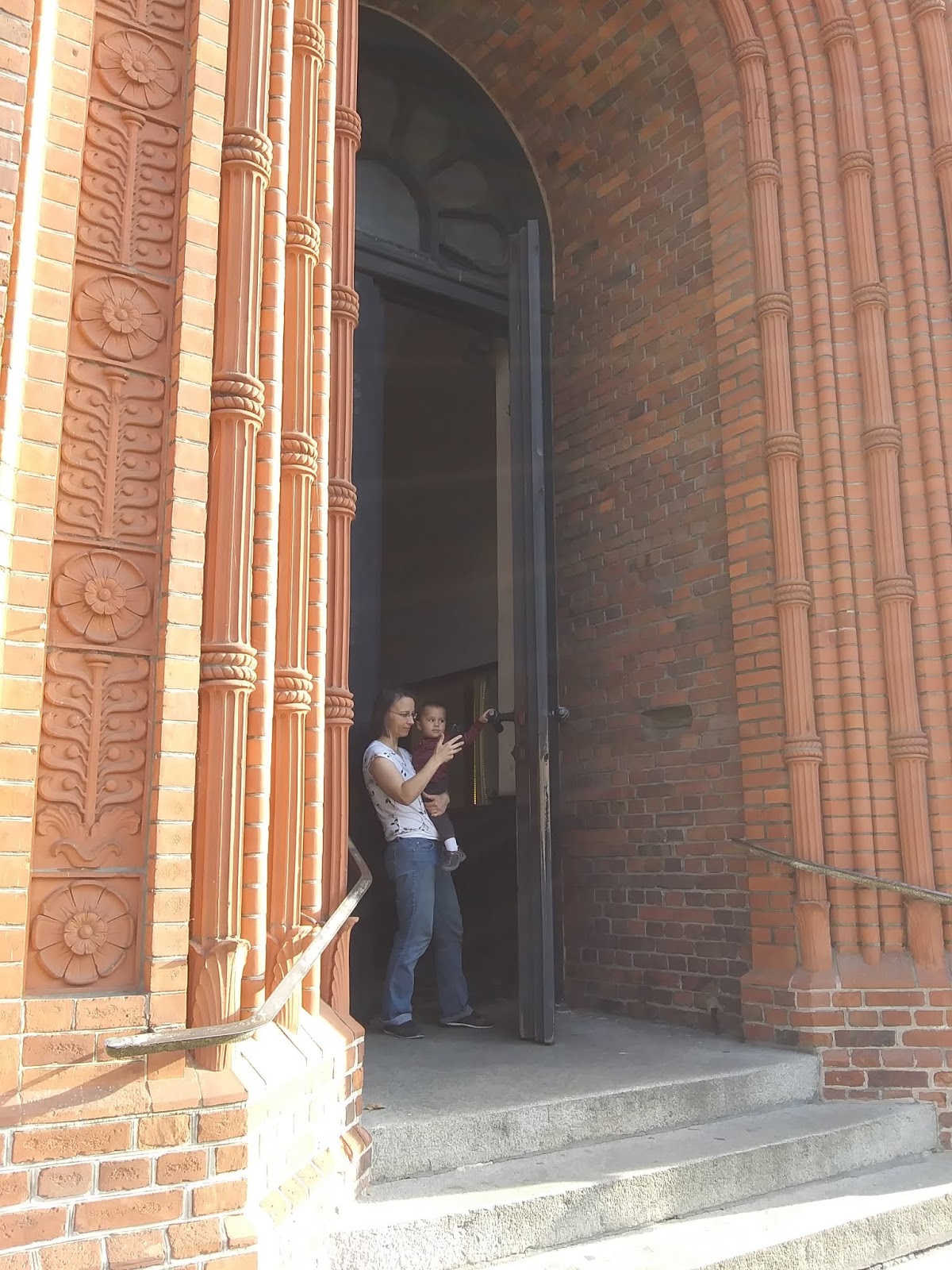
Through those doors I said goodbye to my dad when he left the country.

The neighbors who lived here got us help when my mom and I had carbon monoxide poisoning.


In her "work outfit"


Brda River


validating her trolley ticket


putting in coin to use restroom


praying the Rosary

Outdoor Rosary "stations"


Finally feeling the spirit in this chapel of cloistered nuns


going home... no carseats! eek!