So I thought I was comitted to the CM approach to education but looks like I'm ecclectic through and through. Yes, there are aspects of the method that I still love and intend to incorporate into our homeschool. (I'm thinking here of the history timeline and book of centuries, nature walks with nature journal, copywork - and later dictation - for practice of spelling and handwriting in particular, picture study, classical music appreciation, living books in lieu of textbooks, handicrafts - especially knitting, and an emphasis on character formation.)
So what's preventing me from just calling myself a Charlotte Mason homeschooler, considering the rather long list of CM features I am embracing? First and foremost, while I do agree with the ideal of hours of outside time, ever since I gave up on trying to incorporate mandatory daily outdoor time, my stress levels have lowered! I was feeling guilty for not spending the recommended 4-6 (!) hours outside with the kids when it was too hot and humid for my liking, followed by mosquito infestations at dusk, during the summer. In the winter months, I likewise didn't spend the time outside because bundling up took longer than anyone wanted to actually be outside. Perhaps this year, since we won't have a newborn to worry about, we may be able to spend more time outside once the humidity of summer subsides. But it certainly won't be more than an hour at most daily. We just don't have the desire to spend that much time slugging around trying to find something to do! Sorry, I know nature is fascinating, but 4-6 hours?! That time has to be taken from somewhere - if not chores, then sleep.
Also, while I do love the idea of living books instead of strictly textbooks, I do intend to use textbooks as spines for history and science. I want that list of possible topics at our fingertips to use as a starting point for gauging my kids' interest. There will be lots of reading of living books, but not without first referring to the textbooks.
And while this may not be a "con" per se, serious science study seems to be absent from the CM methodology, and mathematics are not addressed at all. I understand that most CM educators simply supplement for these subjects, but considering that I'd be tinkering with other aspects as well, might as well call myself ecclectic.
Showing posts with label Charlotte Mason. Show all posts
Showing posts with label Charlotte Mason. Show all posts
Thursday, July 27, 2017

Tuesday, July 4, 2017
Catholic Ecclectic Unschooling?!
I recently have had two realizations about our approach to homeschooling. I'm slowly starting to take ownership of it and finding what works and what doesn't. I'm glad that I'm using these preschool years to do this trial and error, so that once we start to report for kindergarten, we can hit the ground running.
Here is a list of subject areas that I am currently working with when planning out lessons for our preschool.
1. practical life skills
2. sensorial
3. literacy
4. numeracy
5. nature/science
6. culture/geography
7. health
8. physical education
9. music & music appreciation
10. art & art appreciation
11. languages (ASL, Polish, Spanish)
12. literature & poetry
13. religion (faith, morals, liturgy, prayer)
I come back to the way I utilize lesson plans after first discussing the first big overhaul of our approach to homeschooling, faith.
At last Sunday's homily, our pastor drove home the point that Christ needs to be at the center of our lives, and that religion cannot be merely one of the areas of our life, something I've been guilty of for sure. The first thing that popped into my mind was that we needed to rethink our homeschooling approach. I pulled out the book on Catholic homeschooling that I got at the Catholic homeschool curriculum fair we attended and started reading.
We always said that we decided to homeschool for various reasons, none of which were religious. But that doesn't mean that we are stuck with a secular homeschool for life! One of the things that really struck me so far from the book was relating how children sent to secular schools to learn "real subjects" and only hearing about God's presence in their lives on the periphery come to think that God has nothing to do with what they're learning in school! Science and History in particular have a way of pretending that God doesn't exist that is detrimental to a person's world view.
As catholic Christians, we believe that God created the universe and everything in it. There is nothing science can discover that doesn't directly point to the glory of God! Evolution (a theory, by the way, not fact) can nonetheless point to the fact that God's days are not limited to our 24-hour-periods, and perhaps the creation story is not something that happened thousands (or millions) of years ago, but rather something that is ongoing. Just like God forms us in our mothers' wombs, but He doesn't stop working on us after birth! To study science without acknowledging God's hand in it is to betray our Christian world-view.
Likewise with history. To look at the events of human history without addressing the role of sin, virtue, and the human longing for something greater than itself is to again miss entirely how God is present in our daily circumstances. Not that He orchestrates what happens, but that He is there with us. That people turn to Him, and He listens. That people turn away from Him, and He forgives (though not without meting out justice). Eliminating God from a history curriculum is pretending that humans don't need God. Again, this is a total contradiction of our Christian world-view.
Other subjects also can either serve to build up the spirit of a young Chrisitan or not. What we read penetrates our imaginations. Are we reading about what is true, good, and beautiful? Or are we reading merely what has always been taught? Just because certain works of literature are famous doesn't make them crucial to read. Likewise for art and music. I agree that there is an element of cultural competency that needs to be addressed, meaning that a person's education ought to prepare them to at least be aware of the existence of things that have shaped our society in meaningful ways - for better or worse. After all, we study wars rather than ignoring them because of the violence, death, and evil it portrays.
But if presented without any commentary from the perspective of the catholic Christian parent, the child is left to possibly conclude that anything famous in the secular world is "good", or "true", or "beautiful". I don't know if I completely agree with the adage, "beauty is in the eye of the beholder". Some things are just plain ugly. The same applies to what is good and true. We live in a relativist society. I am certainly a victim of this mentality. There is no objective truth, therefore there's no objective goodness. Virtue is whatever best suits me, the individual.
***
I'm returning now to the idea of lesson planning. I tried unschooling for several months when Antonio was born, and I was amazed how Natalia continued to learn in various areas without my so much as lifting a finger. Yet after those few months, I decided that we couldn't unschool long term because one of the motivating factors for me to educate my children at home is that I get to teach them!
So I make lesson plans. I try to make sure certain subject areas are covered. I attempt to figure out the best schedule to implement. And over and over I realize that everything always looks perfect on paper, but never works out in real life. Finally it occurred to me that while I love to plan and organize, I also love to stay with a natural flow of learning, following whatever sparks Natalia's curiosity. I tried to sit down with her and do X for a set amount of time one time, and it immediately felt artificial and not at all educational! Perhaps this will change as she gets older. But for now, for preschool, I'm starting to understand what my homeschooling method really is, and it's not any of the official methods out there. I've said we're ecclectic before, but I think I fially understand what that means to me.
Ecclectic homeschooling to me means several things. 1) I make plans and goals so I know what to look out for in terms of library materials, outings, etc. I plan and organize because I enjoy the very process of planning and organizing. I do not intend to meticulously implement any of my plans, and I expect them to be altered and updated periodically. 2) I observe the natural interests and inclinations of Natalia. I answer her questions and find resources for subjects she shows an interest in. I do not interrupt her indpendent play unless absolutely necessary (say, it's time to leave for church). 3) I return to my plans periodically and take note of what has already been learned. I then can move on to the next set of goals in a given subject as I reimagine the lesson plans.
So there is definitely a strong component of unschooling that remains. I think the only thing that isn't "pure unschooling" with us is that I do have subjects in mind for Natalia to be exposed to, and certain skills and knowledge that I do intend for her to learn. Nothing we do is done against her desires, though. She is loving memorizing various things, so why wouldn't I take advantage of this stage of her development and try to surround her with things I think are good for every person to know by heart? (Basic geography comes to mind. She knows her contients and oceans, and we're slowly moving into the concepts of countries. I'm not sure that she would've become interested in geography if I hadn't brought it up and if I wouldn't continue to bring in resources to build on this interest.)
I like labels, and perhaps that's what this is for me - a labeling of what was all along. Ecclectic unschooling with a hint of classical? Because I am drawn to some of the features of the classical approach/Charlotte Mason. What finally did it for me and forced me to cut my emotional ties with CM is the feeling of guilt over not spending hours outside. It just isn't for us, not where we live. I couldn't shake the guilt, so I shook the label instead!
I also think that unit studies may be making an appearance. As I think about incorporating God into our subjects and not just keeping Him in "religion", I instantly think of making unit studies around the liturgical year. I see unit studies as supplemental to a core curriculum, though. I don't want to tie myself to the idea of forcing ever subject into every unit study. History and science may need to unfold along separate timelines!
I'm probably overthinking the whole preschool homeschooling thing, but it's for a good cause - the whole education of both my kids. I think Antonio will benefit from this time, as I will hopefully have an idea of what crucial elements to include in his preschool in a couple of years. I also think Natalia will benefit because by the time we have to officially report her home education in two years, we will have ironed out the details and can hit the ground running without having to second guess ourselves.
Speaking of state reporting, I had to finagle the terminology a little to get from the list of mandatory subjects to the list of our home school subjects above. The mandatory subjects in our state are as follows:
1. language arts (literacy, literature/poetry)
2. math (numeracy)
3. science (nature/science)
4. social studies (culture/geography/history)
5. health (nutrition, safety, hygiene/disease control, exercise, rest, stress avoidance)
6. physical education (gross motor skills)
7. art (& art appreciation)
8. music (& music appreciation)
Confession time - the title to this post just occurred to me, so I think I will address the nuances of this "methodology" in a future post.
Here is a list of subject areas that I am currently working with when planning out lessons for our preschool.
1. practical life skills
2. sensorial
3. literacy
4. numeracy
5. nature/science
6. culture/geography
7. health
8. physical education
9. music & music appreciation
10. art & art appreciation
11. languages (ASL, Polish, Spanish)
12. literature & poetry
13. religion (faith, morals, liturgy, prayer)
I come back to the way I utilize lesson plans after first discussing the first big overhaul of our approach to homeschooling, faith.
At last Sunday's homily, our pastor drove home the point that Christ needs to be at the center of our lives, and that religion cannot be merely one of the areas of our life, something I've been guilty of for sure. The first thing that popped into my mind was that we needed to rethink our homeschooling approach. I pulled out the book on Catholic homeschooling that I got at the Catholic homeschool curriculum fair we attended and started reading.
We always said that we decided to homeschool for various reasons, none of which were religious. But that doesn't mean that we are stuck with a secular homeschool for life! One of the things that really struck me so far from the book was relating how children sent to secular schools to learn "real subjects" and only hearing about God's presence in their lives on the periphery come to think that God has nothing to do with what they're learning in school! Science and History in particular have a way of pretending that God doesn't exist that is detrimental to a person's world view.
As catholic Christians, we believe that God created the universe and everything in it. There is nothing science can discover that doesn't directly point to the glory of God! Evolution (a theory, by the way, not fact) can nonetheless point to the fact that God's days are not limited to our 24-hour-periods, and perhaps the creation story is not something that happened thousands (or millions) of years ago, but rather something that is ongoing. Just like God forms us in our mothers' wombs, but He doesn't stop working on us after birth! To study science without acknowledging God's hand in it is to betray our Christian world-view.
Likewise with history. To look at the events of human history without addressing the role of sin, virtue, and the human longing for something greater than itself is to again miss entirely how God is present in our daily circumstances. Not that He orchestrates what happens, but that He is there with us. That people turn to Him, and He listens. That people turn away from Him, and He forgives (though not without meting out justice). Eliminating God from a history curriculum is pretending that humans don't need God. Again, this is a total contradiction of our Christian world-view.
Other subjects also can either serve to build up the spirit of a young Chrisitan or not. What we read penetrates our imaginations. Are we reading about what is true, good, and beautiful? Or are we reading merely what has always been taught? Just because certain works of literature are famous doesn't make them crucial to read. Likewise for art and music. I agree that there is an element of cultural competency that needs to be addressed, meaning that a person's education ought to prepare them to at least be aware of the existence of things that have shaped our society in meaningful ways - for better or worse. After all, we study wars rather than ignoring them because of the violence, death, and evil it portrays.
But if presented without any commentary from the perspective of the catholic Christian parent, the child is left to possibly conclude that anything famous in the secular world is "good", or "true", or "beautiful". I don't know if I completely agree with the adage, "beauty is in the eye of the beholder". Some things are just plain ugly. The same applies to what is good and true. We live in a relativist society. I am certainly a victim of this mentality. There is no objective truth, therefore there's no objective goodness. Virtue is whatever best suits me, the individual.
***
I'm returning now to the idea of lesson planning. I tried unschooling for several months when Antonio was born, and I was amazed how Natalia continued to learn in various areas without my so much as lifting a finger. Yet after those few months, I decided that we couldn't unschool long term because one of the motivating factors for me to educate my children at home is that I get to teach them!
So I make lesson plans. I try to make sure certain subject areas are covered. I attempt to figure out the best schedule to implement. And over and over I realize that everything always looks perfect on paper, but never works out in real life. Finally it occurred to me that while I love to plan and organize, I also love to stay with a natural flow of learning, following whatever sparks Natalia's curiosity. I tried to sit down with her and do X for a set amount of time one time, and it immediately felt artificial and not at all educational! Perhaps this will change as she gets older. But for now, for preschool, I'm starting to understand what my homeschooling method really is, and it's not any of the official methods out there. I've said we're ecclectic before, but I think I fially understand what that means to me.
Ecclectic homeschooling to me means several things. 1) I make plans and goals so I know what to look out for in terms of library materials, outings, etc. I plan and organize because I enjoy the very process of planning and organizing. I do not intend to meticulously implement any of my plans, and I expect them to be altered and updated periodically. 2) I observe the natural interests and inclinations of Natalia. I answer her questions and find resources for subjects she shows an interest in. I do not interrupt her indpendent play unless absolutely necessary (say, it's time to leave for church). 3) I return to my plans periodically and take note of what has already been learned. I then can move on to the next set of goals in a given subject as I reimagine the lesson plans.
So there is definitely a strong component of unschooling that remains. I think the only thing that isn't "pure unschooling" with us is that I do have subjects in mind for Natalia to be exposed to, and certain skills and knowledge that I do intend for her to learn. Nothing we do is done against her desires, though. She is loving memorizing various things, so why wouldn't I take advantage of this stage of her development and try to surround her with things I think are good for every person to know by heart? (Basic geography comes to mind. She knows her contients and oceans, and we're slowly moving into the concepts of countries. I'm not sure that she would've become interested in geography if I hadn't brought it up and if I wouldn't continue to bring in resources to build on this interest.)
I like labels, and perhaps that's what this is for me - a labeling of what was all along. Ecclectic unschooling with a hint of classical? Because I am drawn to some of the features of the classical approach/Charlotte Mason. What finally did it for me and forced me to cut my emotional ties with CM is the feeling of guilt over not spending hours outside. It just isn't for us, not where we live. I couldn't shake the guilt, so I shook the label instead!
I also think that unit studies may be making an appearance. As I think about incorporating God into our subjects and not just keeping Him in "religion", I instantly think of making unit studies around the liturgical year. I see unit studies as supplemental to a core curriculum, though. I don't want to tie myself to the idea of forcing ever subject into every unit study. History and science may need to unfold along separate timelines!
I'm probably overthinking the whole preschool homeschooling thing, but it's for a good cause - the whole education of both my kids. I think Antonio will benefit from this time, as I will hopefully have an idea of what crucial elements to include in his preschool in a couple of years. I also think Natalia will benefit because by the time we have to officially report her home education in two years, we will have ironed out the details and can hit the ground running without having to second guess ourselves.
Speaking of state reporting, I had to finagle the terminology a little to get from the list of mandatory subjects to the list of our home school subjects above. The mandatory subjects in our state are as follows:
1. language arts (literacy, literature/poetry)
2. math (numeracy)
3. science (nature/science)
4. social studies (culture/geography/history)
5. health (nutrition, safety, hygiene/disease control, exercise, rest, stress avoidance)
6. physical education (gross motor skills)
7. art (& art appreciation)
8. music (& music appreciation)
Confession time - the title to this post just occurred to me, so I think I will address the nuances of this "methodology" in a future post.
Saturday, September 3, 2016
Preschool Week 5
LANGUAGE ARTS
Natalia is enjoying bringing me or Daddy a few of her favorite books to read together. We may need to be focusing more on bedtime reading, as she has gone potty independently several times without the usual "come read to me" request. I've stopped rotating her books on a weekly basis. Instead, if there's books she hasn't touched, I try to bring them to her attention at the start of week two, and keep reading whatever books are holding her current interest. I'll play it by ear when we rotate.
MATH
Natalia is enjoying counting things and telling us how many of something there is, even if it's not always accurate. She has been working on measuring, in particular with feeding the dog. Yesterday, I noticed that she double checked herself the way I usually do. After scooping a certain amount of dry food into Bigos's bowl, she poured it back into the measuring cup to see if it was indeed just one and not less or more. Not sure what would've happened if it weren't the right amount, but it was an interesting development. An interesting development in currency awareness included finding a lucky penny (twice!) on our walks and putting it in her horsey-bank.
I was interested and pleased to find that she liked perusing the "general store" window at the playground, and we began a simple goods-for-currency exchange game where I ordered something, and then asked how much it was, and pretended to give her that much. I was pleased to see she alread has a rudimentary idea of currency.

SCIENCE
This week, we lucked out with a couple of days of great weather, so we clocked in some serious-for-us outside time. This included meals on the deck, one of which led to a rainbow discovery.


It also included a trip to the playground when there weren't other kids to compete with, and we talked about some of the workers we saw - a man cutting the grass, a man picking up the trash, the sewage truck emptying the porta-potty.


We also observed a toad, ants, mushrooms, tried to follow a bird, smelled roses, and picked various goodies for her treasure chest in her nature corner.

When she saw Daddy working on the sidewalk, she jumped up and exclaimed that she wants to get her shovel, which she promptly did, and began helping.


Bubbles and sidewalk chalk completed our outdoor activities.
FOREIGN LANGUAGE
Natalia continues to surprise me with new signs she picks up whenever she watches the available Signing Time videos. She uses certain signs along with the oral word in one of her languages often unprompted.
CRAFTS & SENSORY
I've not organized any artsy-crafty activities this past week. Still need to get some real-world ideas from my mom. For sensorial, there was water play, both in the tub and in the kitchen sink.


She also often helps me with meal prep, and this week it included mixing flour and egg to make nalesniki (crepes), something she didn't love as it dirtied her hands! She likes cracking eggs and handing them to me to empty into the bowl.


Also with sensory experience, I'll have to mention that one of our outdoor times was spent barefoot, her request.

PHYSICAL FITNESS
I'm loving it when she participates with me in my daily yoga practice. She likes to point out when I'm not following the instructor exactly. Her favorite poses involve a chair. We've also started dancing, but she doesn't seem quite as excited about it as I had hoped. She does dance a little with her "sisters" (four main toys - a dino puppet, a plastic triceratops, a stuffed kitty, and a stuffed reindeer).
SOCIALIZING
We had a vet appointment this week, and she was very interested in the injuries of one particular dog that was there, as well as the three small dogs riding in a stroller. We also met with my midwife. In the waiting room, there were other kids, older, playing, but she seemed to not be interested in interacting with them much. Which, if you consider what I'm rereading right now in "Hold Onto Your Kids: Why Parents Need to Matter More than Peers", is nothing to worry about and in fact something to be glad about.
INDEPENDENT PLAY
This is still a work in progress. Some days are better than others.
HABITS
My biggest challenge right now is getting Natalia to feed herself. We used the baby-led weaning approach, so her current refusal to feed herself must be a regression in light of becoming a big sister soon. We have observed her putting her shoes away and some of her toys away, completely unprompted by us, which is wonderful!
"CHARLOTTE MASON PRESCHOOL"
Don't look surprised, but this may not make it onto my permanent list after all. Yes, we made it outside thanks to weather permitting, but I'm not going to shoot for no 4-6 hours daily. 2 I think is plenty, on most pleasant days.


I'm not sure if tea time is for me, as I'm not a very formal person. The idea of making something fancy just for the sake of making it fancy, eh.
I'm also having second thoughts about the need to play classical music regularly, or read poetry or the Bible. There are rhymes in some of the books in her regular book rotation, so I think that is sufficient. And she hears me reading some of my prayers and a Scripture verse every morning as part of my morning prayer, so she does hear God's word, and it's a bit more contextualized, as she knows I'm talking to Jesus, and when I'm quiet and have my eyes closed, I'm listening to Him.
Natalia has not wanted me to sing much of anything lately. At night, she insists on stories instead of singing, so there's been no hymns incorporated. I'm thinking I'll add this to my own regular prayer time, and expose to them that way.
Just like with classical music, I'm having second thoughts about needing to do a proper art study. I don't know what all the classics are, and is my life really that much less rich because of it?
I still have to talk to my mom about the real-world crafts we can plan.
I'm not much of a game person, so I haven't looked into those yet.
Practically speaking, what I really need to be focusing on right now with Natalia is as follows:
* independent play
* self-feeding
* dealing with apparent start of self-weaning (note I said "dealing with", not necesarily "encouraging" - this warrants its own post sometime soon)
* figuring out some sort of workable sleeping "schedule", to nap or not to nap, and a consistent bedtime/wakeup perhaps? (this is in part related to the self-weaning, so should be covered together)
* preparation for her brother's homebirth
So as you can see, there's no reason to complicate things with premature academics when real-world learning is in order :)
Natalia is enjoying bringing me or Daddy a few of her favorite books to read together. We may need to be focusing more on bedtime reading, as she has gone potty independently several times without the usual "come read to me" request. I've stopped rotating her books on a weekly basis. Instead, if there's books she hasn't touched, I try to bring them to her attention at the start of week two, and keep reading whatever books are holding her current interest. I'll play it by ear when we rotate.
MATH
Natalia is enjoying counting things and telling us how many of something there is, even if it's not always accurate. She has been working on measuring, in particular with feeding the dog. Yesterday, I noticed that she double checked herself the way I usually do. After scooping a certain amount of dry food into Bigos's bowl, she poured it back into the measuring cup to see if it was indeed just one and not less or more. Not sure what would've happened if it weren't the right amount, but it was an interesting development. An interesting development in currency awareness included finding a lucky penny (twice!) on our walks and putting it in her horsey-bank.
 |
| just added her lucky penny to her bank |

SCIENCE
This week, we lucked out with a couple of days of great weather, so we clocked in some serious-for-us outside time. This included meals on the deck, one of which led to a rainbow discovery.


It also included a trip to the playground when there weren't other kids to compete with, and we talked about some of the workers we saw - a man cutting the grass, a man picking up the trash, the sewage truck emptying the porta-potty.


We also observed a toad, ants, mushrooms, tried to follow a bird, smelled roses, and picked various goodies for her treasure chest in her nature corner.
 |
| Can you spot the toad? It just jumped into the grass. |

When she saw Daddy working on the sidewalk, she jumped up and exclaimed that she wants to get her shovel, which she promptly did, and began helping.


We observed her plant, in particular noting that when she overwatered it, the excess was stored in the base container but was soaked up by the next day.
 |
| A bit of Reggio Emilia inspiration, nature's treasure chest goodies and a mirror. |
FOREIGN LANGUAGE
Natalia continues to surprise me with new signs she picks up whenever she watches the available Signing Time videos. She uses certain signs along with the oral word in one of her languages often unprompted.
CRAFTS & SENSORY
I've not organized any artsy-crafty activities this past week. Still need to get some real-world ideas from my mom. For sensorial, there was water play, both in the tub and in the kitchen sink.


She also often helps me with meal prep, and this week it included mixing flour and egg to make nalesniki (crepes), something she didn't love as it dirtied her hands! She likes cracking eggs and handing them to me to empty into the bowl.


Also with sensory experience, I'll have to mention that one of our outdoor times was spent barefoot, her request.

PHYSICAL FITNESS
I'm loving it when she participates with me in my daily yoga practice. She likes to point out when I'm not following the instructor exactly. Her favorite poses involve a chair. We've also started dancing, but she doesn't seem quite as excited about it as I had hoped. She does dance a little with her "sisters" (four main toys - a dino puppet, a plastic triceratops, a stuffed kitty, and a stuffed reindeer).
 |
| About to eat an apple found on a walk (under an apple tree). |
We had a vet appointment this week, and she was very interested in the injuries of one particular dog that was there, as well as the three small dogs riding in a stroller. We also met with my midwife. In the waiting room, there were other kids, older, playing, but she seemed to not be interested in interacting with them much. Which, if you consider what I'm rereading right now in "Hold Onto Your Kids: Why Parents Need to Matter More than Peers", is nothing to worry about and in fact something to be glad about.
INDEPENDENT PLAY
This is still a work in progress. Some days are better than others.
HABITS
My biggest challenge right now is getting Natalia to feed herself. We used the baby-led weaning approach, so her current refusal to feed herself must be a regression in light of becoming a big sister soon. We have observed her putting her shoes away and some of her toys away, completely unprompted by us, which is wonderful!
"CHARLOTTE MASON PRESCHOOL"
Don't look surprised, but this may not make it onto my permanent list after all. Yes, we made it outside thanks to weather permitting, but I'm not going to shoot for no 4-6 hours daily. 2 I think is plenty, on most pleasant days.


I'm not sure if tea time is for me, as I'm not a very formal person. The idea of making something fancy just for the sake of making it fancy, eh.
I'm also having second thoughts about the need to play classical music regularly, or read poetry or the Bible. There are rhymes in some of the books in her regular book rotation, so I think that is sufficient. And she hears me reading some of my prayers and a Scripture verse every morning as part of my morning prayer, so she does hear God's word, and it's a bit more contextualized, as she knows I'm talking to Jesus, and when I'm quiet and have my eyes closed, I'm listening to Him.
Natalia has not wanted me to sing much of anything lately. At night, she insists on stories instead of singing, so there's been no hymns incorporated. I'm thinking I'll add this to my own regular prayer time, and expose to them that way.
Just like with classical music, I'm having second thoughts about needing to do a proper art study. I don't know what all the classics are, and is my life really that much less rich because of it?
I still have to talk to my mom about the real-world crafts we can plan.
I'm not much of a game person, so I haven't looked into those yet.
Practically speaking, what I really need to be focusing on right now with Natalia is as follows:
* independent play
* self-feeding
* dealing with apparent start of self-weaning (note I said "dealing with", not necesarily "encouraging" - this warrants its own post sometime soon)
* figuring out some sort of workable sleeping "schedule", to nap or not to nap, and a consistent bedtime/wakeup perhaps? (this is in part related to the self-weaning, so should be covered together)
* preparation for her brother's homebirth
So as you can see, there's no reason to complicate things with premature academics when real-world learning is in order :)
What Eclectic Homeschooling Means to Me
I have to keep reminding myself that we are an eclectic homeschooling family. Just because I like some aspect of a given approach doesn't make us followers of said approach. I keep falling into that sort of literalism, where I start to think I'm, say, a Charlotte Mason kind of homeschooler, but then I worry about the various aspects of that approach that I actually don't see myself incorporating and waste time worrying about it. So here's a quick run down of what currently resonates with me from various approaches I have researched.
Montessori
I had forgotten that we incorporated the elements of developmentally-appropriate independence into Natalia's daily life long ago, and that these have been growing with her. We do not do Montessori trays, even though I have tried. There's a lot of prep that goes into them, and she has shown minimal interest in them. Instead, I've finally looked at what I like about some of the activities, and I've built those skills into our daily life. So dry scooping is now dog feeding. Liquid pouring is now pouring herself drinks at meal times. I don't give her random things to wash/scrub/clean for the sake of practicing those skills. Instead, she actually washes veggies or dishes or her hands with me. She dresses herself, after picking out her outfit for the day. I don't have a dressing frame for her to practice. There's no need for her to know how to do and undo buttons if her clothing doesn't include them. One other aspect of Montessori that I think snuck in long ago has been the simple, wooden surroundings and natural light. Definitely high on our priorities when setting up her playroom and even when purchasing our house - I insisted that there be windows low enough for her to easily see out of at her curent 3 feet tall. This has proven to be an indispensible part of the sort of lifestyle and educational environment I want for my kids. Oh, and we do not own any toys that operate on battery. Period.
To sum up:
* practical life skills encouraged through daily life
* developmentally-appropriate independence encouraged regularly
* simple and natural environment
Charlotte Mason
There are a few specific approaches to learning that I really like from CM, even though most I cannot yet implement. Nature study as a whole has been giving me a headache, as CM recommends an amount of daily outdoor time that seems ridiculous to me, even when it's beautiful outside. This week was the first time we were able to spent a couple of days doing things outside, and I just didn't see the need to spend more than two and a half hours outside. We are not preparing to live outside, so while I definitely value some time outdoors, I was worrying myself for no reason trying to figure out how to be out more. Going forward, as summer comes to a close and decent weather returns, I see us having our windows open a lot, airing out the house, being able to appreciate fresh air that way, and spending a couple of hours a day outside, while also looking at ways to incorporate nature study indoors, such as through our nature corner. I am satisfied with that being sufficiently beneficial. As Natalia gets a bit older, I look forward to her starting a nature journal.
I also really like the CM approach to language arts, which I utilized when I taught adults ESL. Namely, narration, copywork, and dictation, along with a lot of reading for pleasure. I don't foresee spelling word lists or handwriting lessons, or even - hold onto your seat people - formal phonics instruction. In light of what I'll discuss below (under Classical), if memorization comes easily for young children, then I see nothing simpler than mere exposure providing all the memorization Natalia needs in order to internalize what sounds are made by which letters in which contexts, and how words are spelled. I see no reason to interfere with this process by talking about grammar rules and all their varied exceptions. Sounds like a waste of time to me.
While I do like the idea of utilizing living books for our history and social studies, I see two problems with this. One, the ability to aquire all the books that would be necessary to cover any given timeperiod thoroughly. And two, not having anything summarizing how the various books tie in together, at least from my perspective as the facilitator of the information. Instead, I will definitely use some sort of history "spine", yes a dreaded textbook, and branch out from there to find as many living books as possible for each time period being studied. In light of another paragraph below (about Unschooling), I will let Natalia's interest dictate how much time, and how many books, we devote to any given time period, so that if she's not particularly interested in something, at least we covered the basics from the spine.
To sum up:
* nature study as a precursor to later science learning
* nature notebook
* narration, copywork, dicatation, and reading as the core to literacy
* living books whenever possible, more so when interests are high
Classical
Two things resonate with me from this approach. One is the focus on memorization in the early years, because I see no reason not to take full advantage of a child's natural interest in memorizing things. What better time than then to present valuable facts for the child to memorize and then be able to use as a foundation for more in-depth learning later on. Yes, it seems like mere dry facts now, but I'm looking at the big picture, and I think it'll be that much more fun and interesting to delve deep into subjects if Natalia already has a working knowledge of key facts about whatever it is she is studying later on. (Note here that I will pick and choose which subjects will be relevant for memorization work. For instance, there will be no grammar rule or spelling memorization, but things like capital cities or species of the animal kingdom, yes.)
The other thing, which is technically also a part of CM, is the historical timeline. I'm a visual learner, so I love the idea of having a horizontal display of history, something that I wish I would've had access to when studying history myself. I see our curriculum being history-based, so there will always be a large time line that we can always add to as we learn whatever it is we learn from the various subjects we'll be studying.
Both Classical and CM have their own ideas on the importance of foreign language, but as a multilingual family, I see their suggestions of Latin and French as being, shall we say, classist. I absolutely think every person should be comfortable conversing in at least one language other than their native language, but I completely disagree that the decision as to which language it should be, ought to come from outside the family. In our family, Polish and Spanish are co-native languages, and the foreign language that we are studying is ASL.
To sum up:
* memorization of relevant facts in various subjects during the early years
* historical timeline as a visual representation of what we're studying
* importance of foreign language study
Unschooling
I've had a love-hate relationship with the idea of unschooling, but as I become more and more confident in myself as an eclectic homeschooler, I'm realizing that just like with the other approaches, I need to take what resonates and not worry about the rest. I cannot phathom homeschooling without having a pre-planned curriculum. One of the reasons I want to homeschool is because I enjoy that aspect of it. That said, I am completely flexible on taking detours as Natalia's interests dictate. Just because something is on the agenda doesn't mean it must be covered, at least not right then. So in that regard, I am taking the unschooling approach of allowing plenty of time for child-led interests to be pursued. What I don't see is having no direction at the start, because I do think there is value in learning that sometimes we have to do things we may not necessarily love to do. That is an attitude that will come in handy in adulthood. I don't want my kids to grow up expecting to only ever do what they feel like doing, because the world just doesn't operate that way.
I also like John Holt's explanation of how children learn naturally, in particular in his "Learning All the Time" book, and specifically when it comes to early math skills. Rote counting, for instance, is not valued as a skill in itself. Math should be useful, relevant to real life. So my focus will be on talking about and pointing out numbers, groups of items, measurements, money, time, shapes, etc. as we come across them in our daily lives, much like I've done with the practical life skills a la Montessori.
To sum up:
* allowing plenty of freedom and flexibility to veer off the planned curriculum or lesson plan in order to pursue the child's interests until they wane
* a natural approach to numeracy
Reggio Emilia-inspired
Project-based, child-led learning for the early years, this "approach" sounds very similar to Unschooling from the perspective of following the child's interests and seeing the parent as a mentor rather than teacher, but also shares aspects with Montessori regarding the idea of the environment itself being a "third teacher" (RE personifies what is hinted at by Montessori). What's unique about it that resonates with me is the emphasis on documenting the child's work, and a few very specific aspects of play that I want to make an effort incorporating into our preschool.
To sum up:
* keeping a portfolio of the child's work
* using mirrors, light, shadows, and color (mixing in particular, may be my own take)
Bringing it all together, our eclectic homeschool approach is as follows:
NOW
* practical life skills encouraged through daily life
* developmentally-appropriate independence encouraged regularly
* simple and natural environment
* nature study as a precursor to later science learning
* keeping a portfolio of the child's work
* using mirrors, light, shadows, and color (mixing in particular, may be my own take)
* importance of foreign language study
* a natural approach to numeracy
* nature notebook (starting at 4?)
* narration, copywork, dicatation, and reading as the core to literacy (narration and reading 4+?)
* living books whenever possible, more so when interests are high
* memorization of relevant facts in various subjects during the early years (4/5?)
* importance of foreign language study (ongoing)
* historical timeline as a visual representation of what we're studying
* allowing plenty of freedom and flexibility to veer off the planned curriculum or lesson plan in order to pursue the child's interests until they wane (ongoing)
* using mirrors, light, shadows, and color (through Kindergarten)
* I am currently leaning towards Math-U-See as our math curriculum.
* For a science curriculum, I'm interested in Real Science 4 Kids at the moment, but that's because it's the only science curriculum I'm very aware of, thanks to a homeschooling webinar.
* The history curriculum I keep hearing about is The History of the World, but of course it's too soon to commit still.
Montessori
I had forgotten that we incorporated the elements of developmentally-appropriate independence into Natalia's daily life long ago, and that these have been growing with her. We do not do Montessori trays, even though I have tried. There's a lot of prep that goes into them, and she has shown minimal interest in them. Instead, I've finally looked at what I like about some of the activities, and I've built those skills into our daily life. So dry scooping is now dog feeding. Liquid pouring is now pouring herself drinks at meal times. I don't give her random things to wash/scrub/clean for the sake of practicing those skills. Instead, she actually washes veggies or dishes or her hands with me. She dresses herself, after picking out her outfit for the day. I don't have a dressing frame for her to practice. There's no need for her to know how to do and undo buttons if her clothing doesn't include them. One other aspect of Montessori that I think snuck in long ago has been the simple, wooden surroundings and natural light. Definitely high on our priorities when setting up her playroom and even when purchasing our house - I insisted that there be windows low enough for her to easily see out of at her curent 3 feet tall. This has proven to be an indispensible part of the sort of lifestyle and educational environment I want for my kids. Oh, and we do not own any toys that operate on battery. Period.
To sum up:
* practical life skills encouraged through daily life
* developmentally-appropriate independence encouraged regularly
* simple and natural environment
Charlotte Mason
There are a few specific approaches to learning that I really like from CM, even though most I cannot yet implement. Nature study as a whole has been giving me a headache, as CM recommends an amount of daily outdoor time that seems ridiculous to me, even when it's beautiful outside. This week was the first time we were able to spent a couple of days doing things outside, and I just didn't see the need to spend more than two and a half hours outside. We are not preparing to live outside, so while I definitely value some time outdoors, I was worrying myself for no reason trying to figure out how to be out more. Going forward, as summer comes to a close and decent weather returns, I see us having our windows open a lot, airing out the house, being able to appreciate fresh air that way, and spending a couple of hours a day outside, while also looking at ways to incorporate nature study indoors, such as through our nature corner. I am satisfied with that being sufficiently beneficial. As Natalia gets a bit older, I look forward to her starting a nature journal.
I also really like the CM approach to language arts, which I utilized when I taught adults ESL. Namely, narration, copywork, and dictation, along with a lot of reading for pleasure. I don't foresee spelling word lists or handwriting lessons, or even - hold onto your seat people - formal phonics instruction. In light of what I'll discuss below (under Classical), if memorization comes easily for young children, then I see nothing simpler than mere exposure providing all the memorization Natalia needs in order to internalize what sounds are made by which letters in which contexts, and how words are spelled. I see no reason to interfere with this process by talking about grammar rules and all their varied exceptions. Sounds like a waste of time to me.
While I do like the idea of utilizing living books for our history and social studies, I see two problems with this. One, the ability to aquire all the books that would be necessary to cover any given timeperiod thoroughly. And two, not having anything summarizing how the various books tie in together, at least from my perspective as the facilitator of the information. Instead, I will definitely use some sort of history "spine", yes a dreaded textbook, and branch out from there to find as many living books as possible for each time period being studied. In light of another paragraph below (about Unschooling), I will let Natalia's interest dictate how much time, and how many books, we devote to any given time period, so that if she's not particularly interested in something, at least we covered the basics from the spine.
To sum up:
* nature study as a precursor to later science learning
* nature notebook
* narration, copywork, dicatation, and reading as the core to literacy
* living books whenever possible, more so when interests are high
Classical
Two things resonate with me from this approach. One is the focus on memorization in the early years, because I see no reason not to take full advantage of a child's natural interest in memorizing things. What better time than then to present valuable facts for the child to memorize and then be able to use as a foundation for more in-depth learning later on. Yes, it seems like mere dry facts now, but I'm looking at the big picture, and I think it'll be that much more fun and interesting to delve deep into subjects if Natalia already has a working knowledge of key facts about whatever it is she is studying later on. (Note here that I will pick and choose which subjects will be relevant for memorization work. For instance, there will be no grammar rule or spelling memorization, but things like capital cities or species of the animal kingdom, yes.)
The other thing, which is technically also a part of CM, is the historical timeline. I'm a visual learner, so I love the idea of having a horizontal display of history, something that I wish I would've had access to when studying history myself. I see our curriculum being history-based, so there will always be a large time line that we can always add to as we learn whatever it is we learn from the various subjects we'll be studying.
Both Classical and CM have their own ideas on the importance of foreign language, but as a multilingual family, I see their suggestions of Latin and French as being, shall we say, classist. I absolutely think every person should be comfortable conversing in at least one language other than their native language, but I completely disagree that the decision as to which language it should be, ought to come from outside the family. In our family, Polish and Spanish are co-native languages, and the foreign language that we are studying is ASL.
To sum up:
* memorization of relevant facts in various subjects during the early years
* historical timeline as a visual representation of what we're studying
* importance of foreign language study
Unschooling
I've had a love-hate relationship with the idea of unschooling, but as I become more and more confident in myself as an eclectic homeschooler, I'm realizing that just like with the other approaches, I need to take what resonates and not worry about the rest. I cannot phathom homeschooling without having a pre-planned curriculum. One of the reasons I want to homeschool is because I enjoy that aspect of it. That said, I am completely flexible on taking detours as Natalia's interests dictate. Just because something is on the agenda doesn't mean it must be covered, at least not right then. So in that regard, I am taking the unschooling approach of allowing plenty of time for child-led interests to be pursued. What I don't see is having no direction at the start, because I do think there is value in learning that sometimes we have to do things we may not necessarily love to do. That is an attitude that will come in handy in adulthood. I don't want my kids to grow up expecting to only ever do what they feel like doing, because the world just doesn't operate that way.
I also like John Holt's explanation of how children learn naturally, in particular in his "Learning All the Time" book, and specifically when it comes to early math skills. Rote counting, for instance, is not valued as a skill in itself. Math should be useful, relevant to real life. So my focus will be on talking about and pointing out numbers, groups of items, measurements, money, time, shapes, etc. as we come across them in our daily lives, much like I've done with the practical life skills a la Montessori.
To sum up:
* allowing plenty of freedom and flexibility to veer off the planned curriculum or lesson plan in order to pursue the child's interests until they wane
* a natural approach to numeracy
Reggio Emilia-inspired
Project-based, child-led learning for the early years, this "approach" sounds very similar to Unschooling from the perspective of following the child's interests and seeing the parent as a mentor rather than teacher, but also shares aspects with Montessori regarding the idea of the environment itself being a "third teacher" (RE personifies what is hinted at by Montessori). What's unique about it that resonates with me is the emphasis on documenting the child's work, and a few very specific aspects of play that I want to make an effort incorporating into our preschool.
To sum up:
* keeping a portfolio of the child's work
* using mirrors, light, shadows, and color (mixing in particular, may be my own take)
Bringing it all together, our eclectic homeschool approach is as follows:
NOW
* practical life skills encouraged through daily life
* developmentally-appropriate independence encouraged regularly
* simple and natural environment
* nature study as a precursor to later science learning
* keeping a portfolio of the child's work
* using mirrors, light, shadows, and color (mixing in particular, may be my own take)
* importance of foreign language study
* a natural approach to numeracy
* Natalia is taking swimming lessons with Daddy for the next couple of months
* we plan to order Signing Time for our ASL foreign language curriculum soon
* we plan to order Signing Time for our ASL foreign language curriculum soon
LATER (starting around age 6/K except where otherwise noted)
* keeping a portfolio of the child's work (in lieu of testing) (ongoing)* nature notebook (starting at 4?)
* narration, copywork, dicatation, and reading as the core to literacy (narration and reading 4+?)
* living books whenever possible, more so when interests are high
* memorization of relevant facts in various subjects during the early years (4/5?)
* importance of foreign language study (ongoing)
* historical timeline as a visual representation of what we're studying
* allowing plenty of freedom and flexibility to veer off the planned curriculum or lesson plan in order to pursue the child's interests until they wane (ongoing)
* using mirrors, light, shadows, and color (through Kindergarten)
* I am currently leaning towards Math-U-See as our math curriculum.
* For a science curriculum, I'm interested in Real Science 4 Kids at the moment, but that's because it's the only science curriculum I'm very aware of, thanks to a homeschooling webinar.
* The history curriculum I keep hearing about is The History of the World, but of course it's too soon to commit still.
Sunday, August 28, 2016
Preschool Week 4
This week was a lot less structured, if you can call the first three weeks structured to begin with. Trying to scale back on the premature formal academics and instead focus on habit formation, in particular independent play.
LANGUAGE ARTS
No formal sit-down reading times planned. Going through her book rack before swapping books and asking what she likes and doesn't like. If there's a book she says she likes and I know she's looked at it multiple times that week, I'm keeping it in the rack for another week. If she doesn't like the book, and I don't particularly like the book, we are not going to be keeping it. So far, we haven't agreed much on this, so either I could stand to get rid of the book but she says she likes it, or she says "eh" but I really like it and think she'll come back around to it (or her brother will like it).
Also, adding longer, paperback books to her potty bin has been very helpful, as we read these books the most frequently. Even though they're not displayed in any sort of fancy way, she still seems to remember after the first day of rotation what's in there and sometimes asks for a book that's from a different week's rotation.
One newish thing we've been trying to do is add reading as part of bedtime, so when she may not want to go to bed just yet, but we want her to be winding down, so we "allow" her to pick a book or two or three to bring to one of us to read to her. ( One day, after I initially said she could pick one book, once she had it in her hand, I said she could pick two, so she picked an additional one, totalling two books. Sneaky little math "lesson", eh?) This is turning out to be another great way to work read alouds into the day, and it shows which books she's really enjoying.
MATH
Ok, so since abandoning "formal" math "teaching", I think Natalia is teaching herself. When asked how many apples were left on the table for the next day, she went and counted "one, two, three" and reported back that there were three! Another day, she did the same with the accurate number (I think it was 2) again. So since this teaching-herself business seems to be working, we're going to stick with it. (I should note that leaving a tray of fruit that she can easily get to by herself is what encouraged this sudden urge to count, as well as increasing the whole family's fruit intake, as she practices sharing when helping herself, usually to an apple.)
That said, even though I decided not to count "rote counting" as a necessary skill anymore, she has nonetheless reached it anyhow. When asked to count, she counts in the "correct order" 1-10. In English. When prompted in Spanish, she counts in Spanish. When prompted in Polish, she counts in Polish.
I've started pointing out groupings in books and the like by saying how many of something there is without first counting them one by one. The idea is that she associate the number to the real world objects and doesn't think any given number is a "name" for an individual item.
I've been reading up on the Reggio Emilia approach to learning, and one of the things that appeals to me is the focus on light and color and shadows (hence my excitement over the shadows during our late night walk - see the science section below). We also found a neat lesson in observing the color shadows of her shape decals. She was intrigued by the fact that, according to the decal shadows, there were two ovals, but she knows we only have one oval, and one circle. She got up and went to the window to point out this fact!
SCIENCE
Natalia's nature corner gains her attention nearly every day. She gets her treasure box and looks through its content, sometimes with a magnifying glass, sometimes not. I'm trying to encourage her to use her bamboo placemat to keep things more organized. She also reminded me one day when I had forgotten and it was already lunchtime that we need to bring her plant out into the sun for the day.
One night we went walking, the three of us, once it was dark outside, to avoid the nasty heat. With the assistance of a flashlight, we were able to get up close and personal to some flowers, trees, bushes, but also to have some fun learning with shadows. Unfortunately, I have no idea how to capture shadows on photo. But she got a kick out of the giant Natalia with her braided pigtails walking ahead of her on the sidewalk and on fences! When we returned to the house, right before we went in, she found a slug in the grass thanks to her flashlight pointing. We spent another 10-15 minutes observing the snail, picking it up, watching it stay still and then start slithering on my hand. In the end, she finally braved it and touched the snail herself.
FOREIGN LANGUAGE
Even though she hasn't been watching Signing Time daily (it's not "on the schedule" - I play it for her whenever she asks for it, since we don't have all the episodes purchased and are limited to what's available online), she nonetheless is using the new signs she picks up throughout the day. This morning, when Oscar came in to cuddle, upon waking she signed to Daddy in response to something he asked, even before saying anything. Of course now it escapes both of us what that sign was!
CRAFTS & SENSORY
So this was one of the few things "on the schedule" for the week. The artsy idea was a flop. We did crayon rubbings of various textures, but it was mostly me showing her what crayon rubbings were, and then she was ready to move on to something else. So she didn't care for the crayon rubbings or the textured pieces in themselves either. I left the whole set up on her little table for hours, but she never went back to it.
I also gave her a little box of various beads and pompoms, with the idea of this being a sensory experience, but she quickly realized the beads had holes in them, and wanted to make a necklace. (She's played with these same beads many times before, but this was the first time she took note of the holes!) I gave her a few small pipe cleaners and helped her thread a couple on, and she was able to work on this without assistance for a good 10 minutes. We made a necklace and a bracelet for one of her toys. She also remembered that there were a few other beads on a necklace elsewhere in her room, so she went to get it and asked me to untie the ends so that we could add those beads to her box. I'm going to need to get better pipe cleaners for her to work on this, as the ones I have are Christmasy, and as such sparkly and a bit messy, plus not very soft.
Also under sensory activities, we have to include water play. This week, this was limited to bath time, during which time she did some "swimming" practice (laying in the water and blowing bubbles into the water), but also squirting with some bath animals, washing her plastic dinosaur, and sticking foam letters onto the side of the tub. When putting them away, she's shown she recognizes a new letter -"W", and counts the items as she takes them out - language arts and math without ever being on the schedule!
Natalia has also started to show a bit more interest in her easel, especially since I rearranged her playroom a bit and it has been left out, right by the door to the room. (It was previously inside the closet next to her doll house.) Almost daily, I see that she has stopped to draw or write something on the blackboard. I'm careful not to guess what it is, and instead, ask her. I'm getting some pretty creative responses.
PHYSICAL FITNESS
This is really a section for me to stay accountable rather than her. At her age, it takes effort NOT to be running around burning off calories all day long! But since I've become intentional about fitting prenatal yoga into our daily routine, Natalia has started joining me in some of the poses. I follow a YouTube video, and sometimes she compares what I'm doing to what the instructor is doing and corrects me! At times, I can hear her taking in slow, deep breaths. Other times, she just plays in the vicinity and waits for my practice to be over.

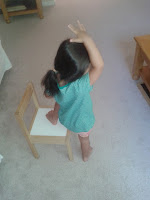
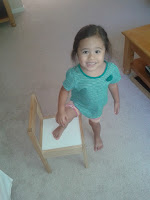
One time, when I was using a yoga ball, she came up behind me and placed her hand on my back, saying "relax, peace, good" - cues that she's learned from participating in a HypnoBabies script Oscar was reading to me, in preparation for birth. (Perhaps not exactly "physical fitness" in the traditional sense of the word, but certainly in the realm of health :) )
SOCIALIZATION
She had two Skype sessions this week, one with my mom and another with my grandmother and aunt. This also reinforced her Polish. In addition, we went to a restaurant for dinner one night, to church, and we had some friends over the house yesterday. Even though the adults mostly spoke among themselves, she was able to introduce her "friends" (toys) to our guests, and charmed one of them into playing especially well with her. There was a little girl, about 10 months old, also here, so they enjoyed the air coming out of the A/C vent together. She had also planned on scaring one of our guests with the assistance of her dinosaur, because I had mentioned to her that this friend enjoys being scared (which she said she does). So she looked forward to the get-together and got a real kick out of yelling "boo" as if the dinosaur was saying it. She practiced greeting our guests and saying goodbye to them and taking turns at the table and in conversation.
When everyone left, I was able to reflect on the importance of Natalia referring to these adults as HER friends. And why not? Why would she be limited to only friends her own age? We don't impose such restrictions on adults! So I'm feeling very good now about our approach to socializing, without contrived same-age groupings that honestly, I think do more harm than good if not kept in check.
INDEPENDENT PLAY
This week, I removed all ideas of scheduled activities and focuses on encouraging independent play. I am happy to report that this "deschooling" of myself has already started to bear fruit. Here's what we're doing. First of all, I don't carry my phone with me everywhere I go, which would encourage constant checking and Natalia would just see me looking at a screen and be reminded of her own screen time. Second, if she was playing on her own and no one was in danger, I LEFT HER ALONE! I didn't join in. I didn't make suggestions. I didn't comment. I also didn't call her away from her play for meals or to start bed time. It seems that she plays independently the best towards the evening, but luckily I do not need to be at work in the morning, so we are flexible on when she goes to sleep.
Also, when she did want my participation in her play, I would humor her, but only minimally. I'd do my best to try to turn questions on their heads instead of giving her solutions. I literally found myself sitting on my hands and biting my lip to let her play how she wanted. At times, I had to go start an activity with her to gain her interest, and then I'd quietly withdraw. Once she was enthralled in her play for a while without coming to me for anything, I'd leave the room for a bit. If gone too long, she'd come looking for me, and I found that I couldn't get on the computer in the next room just yet. So I started to just sit in her room and read a book silently to myself. Or even across the hall in the bathroom with the door open!
On one occasion, she played like this on her own for a good hour! Another time it was around 45 minutes, and several sessions of 20 minutes or so. The biggest hurdle was myself. I'm so used to being hands-on when it comes to playtime, that it was difficult for me to just observe quietly. But I'm seeing the benefits, and the goal is for her to consistently entertain herself for at least a half hour at a time with me in another room. It seems that if I'm up and doing something - cleaning, for instance - she doesn't look for me. But the moment I sit down to the computer, she somehow senses that I'm "not doing anything" and stops playing independently.
HABITS
Aside from socializing and independent play, I've been trying to bring Montessori-inspired activities into our everyday lives, instead of concockting artificial experiences that are more appropriate for a preschool setting than home. Instead of giving her a tray with cutting as a skill to practice, I let her cut up all the mushrooms for our lunch one day. She followed that up with wanting to cut up some banana for her cereal on another day. I give her a plastic knife and leave her to her work.
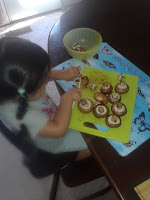
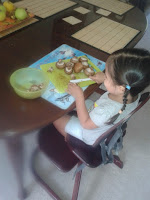
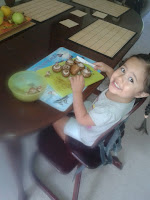
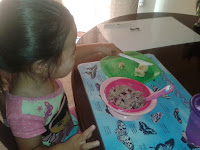
Another daily new thing is letting her pour her own drink - usually water - at the table. I give her a small pitcher with what she's drinking, and let her fill it, drink, refill as needed. The first day, I only gave her enough to fill her cup half way. But the second day, I got brave and gave her more water than could fit in the cup, trusting that if she was paying enough attention to what she was doing, she'd know to stop pouring before it was too late. And she did! One time she literally caught herself with the water already bulging above her cup, looking to me for guidance on what to do next. I showed her how to slurp the excess off the top (!), and she hasn't overfilled her cup again.
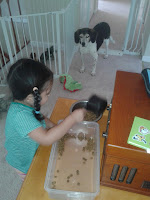
Along the same lines, instead of giving her a scooping activity, which I've tried multiple times with very limited success with various materials (dry beans, dry pasta, rice, cornmeal), Natalia is in charge of feeding our dog, Bigos. She is still working on staying consistent with the correct amount to scoop, so this is a supervised activity. She can open the door to where the dog food is kept, she can open the bag of dog food, and she can scoop the food into the bowl, as we keep both measuring cup and bowl next to the food. However, we have to keep the dog away long enough for Natalia to prepare the meal, and then we have to open the gate for her to place the bowl where it goes. In the picture below, we were still mixing Bigos's old and new food, so we had a separate container.

She also has started to ask to floss - her own teeth and mine! She saw this in a Signing Time video.

CHARLOTTE MASON PRESCHOOL
This is the newest take I want to introduce into our preschool, very laid back, which I discuss in my previous post here. Since I haven't had a chance to implement any of these ideas, them being brand new to me and all, there's nothing to say about it yet. But in future weeks, I will have a section on our progress in this area.
LANGUAGE ARTS
No formal sit-down reading times planned. Going through her book rack before swapping books and asking what she likes and doesn't like. If there's a book she says she likes and I know she's looked at it multiple times that week, I'm keeping it in the rack for another week. If she doesn't like the book, and I don't particularly like the book, we are not going to be keeping it. So far, we haven't agreed much on this, so either I could stand to get rid of the book but she says she likes it, or she says "eh" but I really like it and think she'll come back around to it (or her brother will like it).
Also, adding longer, paperback books to her potty bin has been very helpful, as we read these books the most frequently. Even though they're not displayed in any sort of fancy way, she still seems to remember after the first day of rotation what's in there and sometimes asks for a book that's from a different week's rotation.
One newish thing we've been trying to do is add reading as part of bedtime, so when she may not want to go to bed just yet, but we want her to be winding down, so we "allow" her to pick a book or two or three to bring to one of us to read to her. ( One day, after I initially said she could pick one book, once she had it in her hand, I said she could pick two, so she picked an additional one, totalling two books. Sneaky little math "lesson", eh?) This is turning out to be another great way to work read alouds into the day, and it shows which books she's really enjoying.
MATH
Ok, so since abandoning "formal" math "teaching", I think Natalia is teaching herself. When asked how many apples were left on the table for the next day, she went and counted "one, two, three" and reported back that there were three! Another day, she did the same with the accurate number (I think it was 2) again. So since this teaching-herself business seems to be working, we're going to stick with it. (I should note that leaving a tray of fruit that she can easily get to by herself is what encouraged this sudden urge to count, as well as increasing the whole family's fruit intake, as she practices sharing when helping herself, usually to an apple.)
That said, even though I decided not to count "rote counting" as a necessary skill anymore, she has nonetheless reached it anyhow. When asked to count, she counts in the "correct order" 1-10. In English. When prompted in Spanish, she counts in Spanish. When prompted in Polish, she counts in Polish.
I've started pointing out groupings in books and the like by saying how many of something there is without first counting them one by one. The idea is that she associate the number to the real world objects and doesn't think any given number is a "name" for an individual item.
 |
| Very cool color and light experience. |
SCIENCE
Natalia's nature corner gains her attention nearly every day. She gets her treasure box and looks through its content, sometimes with a magnifying glass, sometimes not. I'm trying to encourage her to use her bamboo placemat to keep things more organized. She also reminded me one day when I had forgotten and it was already lunchtime that we need to bring her plant out into the sun for the day.
One night we went walking, the three of us, once it was dark outside, to avoid the nasty heat. With the assistance of a flashlight, we were able to get up close and personal to some flowers, trees, bushes, but also to have some fun learning with shadows. Unfortunately, I have no idea how to capture shadows on photo. But she got a kick out of the giant Natalia with her braided pigtails walking ahead of her on the sidewalk and on fences! When we returned to the house, right before we went in, she found a slug in the grass thanks to her flashlight pointing. We spent another 10-15 minutes observing the snail, picking it up, watching it stay still and then start slithering on my hand. In the end, she finally braved it and touched the snail herself.
 |
| A great end to a late evening walk. |
Even though she hasn't been watching Signing Time daily (it's not "on the schedule" - I play it for her whenever she asks for it, since we don't have all the episodes purchased and are limited to what's available online), she nonetheless is using the new signs she picks up throughout the day. This morning, when Oscar came in to cuddle, upon waking she signed to Daddy in response to something he asked, even before saying anything. Of course now it escapes both of us what that sign was!
CRAFTS & SENSORY
So this was one of the few things "on the schedule" for the week. The artsy idea was a flop. We did crayon rubbings of various textures, but it was mostly me showing her what crayon rubbings were, and then she was ready to move on to something else. So she didn't care for the crayon rubbings or the textured pieces in themselves either. I left the whole set up on her little table for hours, but she never went back to it.
 |
| The flop - crayon rubbings and textured material. |
 |
| The success: we will be adding more threading activities! |
Natalia has also started to show a bit more interest in her easel, especially since I rearranged her playroom a bit and it has been left out, right by the door to the room. (It was previously inside the closet next to her doll house.) Almost daily, I see that she has stopped to draw or write something on the blackboard. I'm careful not to guess what it is, and instead, ask her. I'm getting some pretty creative responses.
 |
| This is a picture of "ongos" (mushrooms) that we had observed in the yard earlier that day. |
This is really a section for me to stay accountable rather than her. At her age, it takes effort NOT to be running around burning off calories all day long! But since I've become intentional about fitting prenatal yoga into our daily routine, Natalia has started joining me in some of the poses. I follow a YouTube video, and sometimes she compares what I'm doing to what the instructor is doing and corrects me! At times, I can hear her taking in slow, deep breaths. Other times, she just plays in the vicinity and waits for my practice to be over.


One time, when I was using a yoga ball, she came up behind me and placed her hand on my back, saying "relax, peace, good" - cues that she's learned from participating in a HypnoBabies script Oscar was reading to me, in preparation for birth. (Perhaps not exactly "physical fitness" in the traditional sense of the word, but certainly in the realm of health :) )


 |
| Ready to read my HypnoBabies script with daddy. |
She had two Skype sessions this week, one with my mom and another with my grandmother and aunt. This also reinforced her Polish. In addition, we went to a restaurant for dinner one night, to church, and we had some friends over the house yesterday. Even though the adults mostly spoke among themselves, she was able to introduce her "friends" (toys) to our guests, and charmed one of them into playing especially well with her. There was a little girl, about 10 months old, also here, so they enjoyed the air coming out of the A/C vent together. She had also planned on scaring one of our guests with the assistance of her dinosaur, because I had mentioned to her that this friend enjoys being scared (which she said she does). So she looked forward to the get-together and got a real kick out of yelling "boo" as if the dinosaur was saying it. She practiced greeting our guests and saying goodbye to them and taking turns at the table and in conversation.
When everyone left, I was able to reflect on the importance of Natalia referring to these adults as HER friends. And why not? Why would she be limited to only friends her own age? We don't impose such restrictions on adults! So I'm feeling very good now about our approach to socializing, without contrived same-age groupings that honestly, I think do more harm than good if not kept in check.
INDEPENDENT PLAY
This week, I removed all ideas of scheduled activities and focuses on encouraging independent play. I am happy to report that this "deschooling" of myself has already started to bear fruit. Here's what we're doing. First of all, I don't carry my phone with me everywhere I go, which would encourage constant checking and Natalia would just see me looking at a screen and be reminded of her own screen time. Second, if she was playing on her own and no one was in danger, I LEFT HER ALONE! I didn't join in. I didn't make suggestions. I didn't comment. I also didn't call her away from her play for meals or to start bed time. It seems that she plays independently the best towards the evening, but luckily I do not need to be at work in the morning, so we are flexible on when she goes to sleep.
Also, when she did want my participation in her play, I would humor her, but only minimally. I'd do my best to try to turn questions on their heads instead of giving her solutions. I literally found myself sitting on my hands and biting my lip to let her play how she wanted. At times, I had to go start an activity with her to gain her interest, and then I'd quietly withdraw. Once she was enthralled in her play for a while without coming to me for anything, I'd leave the room for a bit. If gone too long, she'd come looking for me, and I found that I couldn't get on the computer in the next room just yet. So I started to just sit in her room and read a book silently to myself. Or even across the hall in the bathroom with the door open!
On one occasion, she played like this on her own for a good hour! Another time it was around 45 minutes, and several sessions of 20 minutes or so. The biggest hurdle was myself. I'm so used to being hands-on when it comes to playtime, that it was difficult for me to just observe quietly. But I'm seeing the benefits, and the goal is for her to consistently entertain herself for at least a half hour at a time with me in another room. It seems that if I'm up and doing something - cleaning, for instance - she doesn't look for me. But the moment I sit down to the computer, she somehow senses that I'm "not doing anything" and stops playing independently.
HABITS
Aside from socializing and independent play, I've been trying to bring Montessori-inspired activities into our everyday lives, instead of concockting artificial experiences that are more appropriate for a preschool setting than home. Instead of giving her a tray with cutting as a skill to practice, I let her cut up all the mushrooms for our lunch one day. She followed that up with wanting to cut up some banana for her cereal on another day. I give her a plastic knife and leave her to her work.


Another daily new thing is letting her pour her own drink - usually water - at the table. I give her a small pitcher with what she's drinking, and let her fill it, drink, refill as needed. The first day, I only gave her enough to fill her cup half way. But the second day, I got brave and gave her more water than could fit in the cup, trusting that if she was paying enough attention to what she was doing, she'd know to stop pouring before it was too late. And she did! One time she literally caught herself with the water already bulging above her cup, looking to me for guidance on what to do next. I showed her how to slurp the excess off the top (!), and she hasn't overfilled her cup again.
Along the same lines, instead of giving her a scooping activity, which I've tried multiple times with very limited success with various materials (dry beans, dry pasta, rice, cornmeal), Natalia is in charge of feeding our dog, Bigos. She is still working on staying consistent with the correct amount to scoop, so this is a supervised activity. She can open the door to where the dog food is kept, she can open the bag of dog food, and she can scoop the food into the bowl, as we keep both measuring cup and bowl next to the food. However, we have to keep the dog away long enough for Natalia to prepare the meal, and then we have to open the gate for her to place the bowl where it goes. In the picture below, we were still mixing Bigos's old and new food, so we had a separate container.


She also has started to ask to floss - her own teeth and mine! She saw this in a Signing Time video.
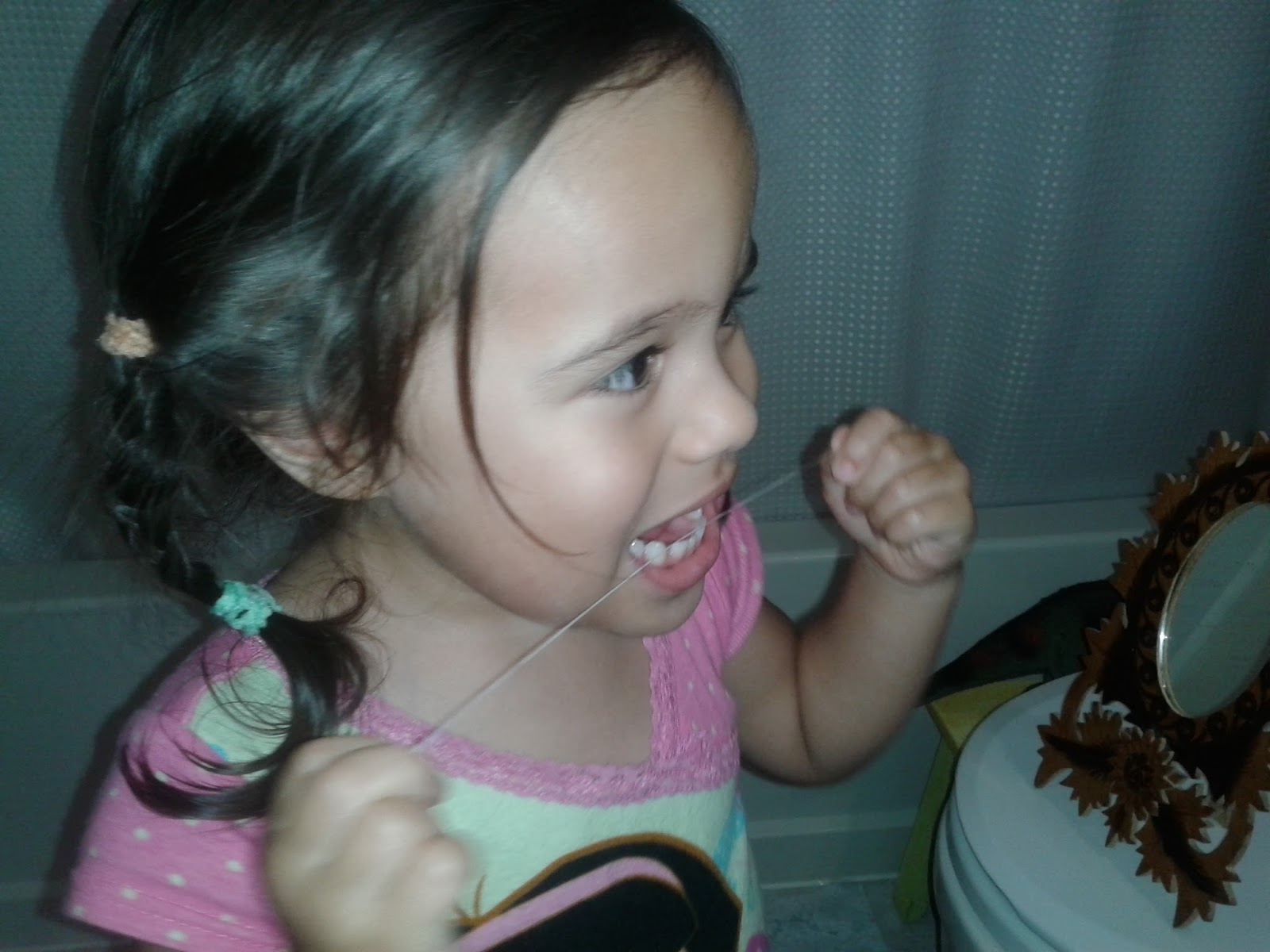
CHARLOTTE MASON PRESCHOOL
This is the newest take I want to introduce into our preschool, very laid back, which I discuss in my previous post here. Since I haven't had a chance to implement any of these ideas, them being brand new to me and all, there's nothing to say about it yet. But in future weeks, I will have a section on our progress in this area.
Friday, August 26, 2016
Preschool Goals
Probably not what you think. Charlotte Mason-based, mostly, with some adjustments for our multicultural family. Ok, so CM advocated delaying formal academics (reading/writing/arithmatic) until around age 6 or 7, which works out beautifully, bc both my kids' birthdays fall late enough in the year that they are not required to "do Kindergarten" until shortly before the will turn 6. That said, I still wanted to gather some CM-inspired activities to give us things to do during the day, always with the understanding that they'll be free to go off and pursue their own interests unencumbered by me or a preset curriculum. But we'll have a loose curriculum to come back to when they start to get bored or restless.
That said, one interesting thing I just read about CM "year 0" (based on the free online CM curriculum, Ambleside, which refers to all the years prior to start of official academics, so preschool included) is to focus these years on, first and foremost, spending free time outdoors. Then, it's a good idea to incorporate the so-called "extras", what perhaps might be "electives" in formal school, but what I'd instead call "non-academic" interests and activities, bc "extras" makes it sound unnecessary, and I think everything my kids study should be "elected" by them to some degree.
Ok, so CM includes the following as these non-academic "subjects" that we can work into our preschool time: art appreciation, classical music, hymn study, folk songs, tea time, handicrafts, foreign language, and play card/board games.
We recently had a flop with our attempt at art study, so I'm going to shelf that idea for another year or so, or at least until I am able to acquire an art book or art postcards to use for this purpose. That said, CM includes sculpture and architecture here, not just painting, which I think is great. However, the particular list of art seems very heavily Western, and I'd much rather include art expressions from around the world. For the time being, I think we may want to consider an art museum, especially if it features one of the art pieces we did have a chance to study already. And I'll keep an eye out for any festivals or events that may feature traditional art.
Similarly with classical music. Skipping ahead to tea time, this may be a good time to put on the classical music for now, because I can't just have it on all day (any background sounds annoy me!)
Hymn study I'd like to base from my prayer book, in Polish. There are hymns in there that lift my spirits that I'd welcome incorporating into our regular daily life. So far, we sing Jeremy Camp's "Give Me Jesus" most mornings (it starts, "in the morning..."), and Natalia's even asked to sing it to visitors at our home! So I think this will be a good idea, perhaps a new hymn every month, focusing on just the first verse for now.
Folk songs I don't really know what is meant by this, and I'm not really very keen on incorporating it at this time.
Tea time sounds like a variation of what I remember growing up with, which we called "kawka" (little coffee). The idea is to take a quiet time each day, ideally mid-afternoon, for some fancy tea and a bit of snacks (practice care of delicate items, manners), and play some classical music, read a verse from the Bible, or a poem, something short and sweet for us for now. And just hang out screen-free until our snack and tea is finished. Sounds like a great way to sneak in a bit of possible "memory work" and of course exposure to classical music.
Handicrafts a la CM really spark my interest. I'm not a very crafty person, but I have been trying to incorporate at least one craft every week for Natalia. The CM approach would be to focus not on doing arts and crafts as an end in themselves, but as a way to work on a skill that can continue to be useful in adulthood, in particular something that can be useful in fixing things around the house or creating gifts for others. A lot of what was listed is currently over my head, and most of it is probably too advanced for a three year old (like knitting). But we can definitely make Christmas ornaments this year, and I'm really excited about that! I like the idea of these creations being useful, not just something we display on the fridge until the next week's project replaces it. I'll have to think of what else we can do now, but many things come rushing back from my own childhood, so I'm excited to ask my mom for ideas! Doll/puppet making, knitting, napkin folding, woodworking, needlepoint, Christmas ornaments, these are all things I remember from childhood, and how sad I've forgotten most of these skills, but look forward to regaining them with my kids!
Foreign language in our home is ASL, and for now we are working with the free Youtube videos of Signing Time. We are going to be budgeting in purchasing the full episodes of Signing Time to base our further study of ASL. Formal study of Polish will begin probably next year for Natalia, when we plan to start her in Saturday Polish school. Still not sure if this is something that will be a long-term commitment or not. Also don't know if Spanish will find a formal expression somewhere. For now, daily communication, books, and occasional shows in our languages provide the informal language learning environment that we prefer.
Playing card/board games is something else that I need to look into. I'm not much into games, but I do remember playing Yahtzee with my parents when my mom was expecting my sister (so I was 9). I enjoy playing Uno, I've played Operation, Monopoly, and Master Mind (we do have this game, but it's way too advanced right now for Natalia). I suppose the point of these games is to work on teamwork/cooperation (if the right games are chosen), as well as pre-literacy & pre-numeracy skills? I'll keep my eye out for these, but nothing formal is currently in the works.
However, these are the "extras" that CM offers. There is one thing that is most definitely to be encouraged to the exclusion of all other things if need be (even reading!), during these preschool years, and that's time spent outdoors. This is going to be a big challenge for us. We live in a climate where the 3-4 month summers are very hot and humid, definitely not conducive to daily nature walks. And when it starts to get more bearable as the evening dawns, the mosquitos come out. So really, the only decent time to be outside most summers is at night. I suppose early mornings, too, but we are night owls, and I do not see us rising early enough to beat the heat of the morning sun!
Yesterday we went for a late night walk. I believe it was 8:45pm when we headed out. The sun was long gone, the stars were out, and with flashlight in hand, we walked for a good half hour before spending an additional 10-15 minutes outside our house observing a slug. It was an amazing walk, what I think is the very goal of nature study. I hope that as the summer ends, the days will become more conducive to daily walks, which I think are the easiest and most natural (sic!) way to do nature study. Right now, we're sort of struggling to find nature inside - with our nature corner, with pointing out clouds through the window, with visits to the pet store or just caring for our dog.
There's been no bird watching since we made it a point to look for them, even though there were lots of birds in our yard when we first moved here. Perhaps cutting most of our trees was a contributing factor, perhaps it's the time of year. Hopefully next year, bird watching will be a solid nature study for the ugly summer months. But I like the idea of late night walks outside, except that Oscar needs to get to bed by a reasonable hour, and I don't feel comfortable meandering outside that late without his company. But we do have a fenced in yard! So I'm going to try to start spending time outside as part of our wind-down time once the sun has set and most mosquitos are gone. We can swing in the hammock and watch the stars! We can eat our kolacja (supper) on the deck. But CM would have kids this age outside for 4-6 hours DAILY! This is simply never going to happen in our climate, though I am willing to try during the milder months of the year.
So to recap, #1 priority: get outdoors at some point during the day or night, every day. Start with 30 minutes daily, work up to an hour daily.
2. Start the tradition of tea time in the afternoon, with exposure to classical music, reading a poem, reading a Bible verse, setting and clearing the table, and having some tea and snacks in a fancy way.
3. Start singing my favorite Polish hymns, one per month, one verse only for now.
4. Get ideas for useful handicrafts from my mom, look online for age-appropriate ideas, and focus on these instead of generic arts and crafts.
5. Budget for an art book and/or art postcards; budget for Signing Time episodes.
6. Look into preschool games that we can incorporate into our preschool.
And I would be remiss if I didn't mention THE most important goal right now, and that is working on Natalia's independent play. We have been working on this this week, and I'll be reporting on it in our weekly preschool recap.
That said, one interesting thing I just read about CM "year 0" (based on the free online CM curriculum, Ambleside, which refers to all the years prior to start of official academics, so preschool included) is to focus these years on, first and foremost, spending free time outdoors. Then, it's a good idea to incorporate the so-called "extras", what perhaps might be "electives" in formal school, but what I'd instead call "non-academic" interests and activities, bc "extras" makes it sound unnecessary, and I think everything my kids study should be "elected" by them to some degree.
Ok, so CM includes the following as these non-academic "subjects" that we can work into our preschool time: art appreciation, classical music, hymn study, folk songs, tea time, handicrafts, foreign language, and play card/board games.
We recently had a flop with our attempt at art study, so I'm going to shelf that idea for another year or so, or at least until I am able to acquire an art book or art postcards to use for this purpose. That said, CM includes sculpture and architecture here, not just painting, which I think is great. However, the particular list of art seems very heavily Western, and I'd much rather include art expressions from around the world. For the time being, I think we may want to consider an art museum, especially if it features one of the art pieces we did have a chance to study already. And I'll keep an eye out for any festivals or events that may feature traditional art.
Similarly with classical music. Skipping ahead to tea time, this may be a good time to put on the classical music for now, because I can't just have it on all day (any background sounds annoy me!)
Hymn study I'd like to base from my prayer book, in Polish. There are hymns in there that lift my spirits that I'd welcome incorporating into our regular daily life. So far, we sing Jeremy Camp's "Give Me Jesus" most mornings (it starts, "in the morning..."), and Natalia's even asked to sing it to visitors at our home! So I think this will be a good idea, perhaps a new hymn every month, focusing on just the first verse for now.
Folk songs I don't really know what is meant by this, and I'm not really very keen on incorporating it at this time.
Tea time sounds like a variation of what I remember growing up with, which we called "kawka" (little coffee). The idea is to take a quiet time each day, ideally mid-afternoon, for some fancy tea and a bit of snacks (practice care of delicate items, manners), and play some classical music, read a verse from the Bible, or a poem, something short and sweet for us for now. And just hang out screen-free until our snack and tea is finished. Sounds like a great way to sneak in a bit of possible "memory work" and of course exposure to classical music.
Handicrafts a la CM really spark my interest. I'm not a very crafty person, but I have been trying to incorporate at least one craft every week for Natalia. The CM approach would be to focus not on doing arts and crafts as an end in themselves, but as a way to work on a skill that can continue to be useful in adulthood, in particular something that can be useful in fixing things around the house or creating gifts for others. A lot of what was listed is currently over my head, and most of it is probably too advanced for a three year old (like knitting). But we can definitely make Christmas ornaments this year, and I'm really excited about that! I like the idea of these creations being useful, not just something we display on the fridge until the next week's project replaces it. I'll have to think of what else we can do now, but many things come rushing back from my own childhood, so I'm excited to ask my mom for ideas! Doll/puppet making, knitting, napkin folding, woodworking, needlepoint, Christmas ornaments, these are all things I remember from childhood, and how sad I've forgotten most of these skills, but look forward to regaining them with my kids!
Foreign language in our home is ASL, and for now we are working with the free Youtube videos of Signing Time. We are going to be budgeting in purchasing the full episodes of Signing Time to base our further study of ASL. Formal study of Polish will begin probably next year for Natalia, when we plan to start her in Saturday Polish school. Still not sure if this is something that will be a long-term commitment or not. Also don't know if Spanish will find a formal expression somewhere. For now, daily communication, books, and occasional shows in our languages provide the informal language learning environment that we prefer.
Playing card/board games is something else that I need to look into. I'm not much into games, but I do remember playing Yahtzee with my parents when my mom was expecting my sister (so I was 9). I enjoy playing Uno, I've played Operation, Monopoly, and Master Mind (we do have this game, but it's way too advanced right now for Natalia). I suppose the point of these games is to work on teamwork/cooperation (if the right games are chosen), as well as pre-literacy & pre-numeracy skills? I'll keep my eye out for these, but nothing formal is currently in the works.
However, these are the "extras" that CM offers. There is one thing that is most definitely to be encouraged to the exclusion of all other things if need be (even reading!), during these preschool years, and that's time spent outdoors. This is going to be a big challenge for us. We live in a climate where the 3-4 month summers are very hot and humid, definitely not conducive to daily nature walks. And when it starts to get more bearable as the evening dawns, the mosquitos come out. So really, the only decent time to be outside most summers is at night. I suppose early mornings, too, but we are night owls, and I do not see us rising early enough to beat the heat of the morning sun!
Yesterday we went for a late night walk. I believe it was 8:45pm when we headed out. The sun was long gone, the stars were out, and with flashlight in hand, we walked for a good half hour before spending an additional 10-15 minutes outside our house observing a slug. It was an amazing walk, what I think is the very goal of nature study. I hope that as the summer ends, the days will become more conducive to daily walks, which I think are the easiest and most natural (sic!) way to do nature study. Right now, we're sort of struggling to find nature inside - with our nature corner, with pointing out clouds through the window, with visits to the pet store or just caring for our dog.
There's been no bird watching since we made it a point to look for them, even though there were lots of birds in our yard when we first moved here. Perhaps cutting most of our trees was a contributing factor, perhaps it's the time of year. Hopefully next year, bird watching will be a solid nature study for the ugly summer months. But I like the idea of late night walks outside, except that Oscar needs to get to bed by a reasonable hour, and I don't feel comfortable meandering outside that late without his company. But we do have a fenced in yard! So I'm going to try to start spending time outside as part of our wind-down time once the sun has set and most mosquitos are gone. We can swing in the hammock and watch the stars! We can eat our kolacja (supper) on the deck. But CM would have kids this age outside for 4-6 hours DAILY! This is simply never going to happen in our climate, though I am willing to try during the milder months of the year.
So to recap, #1 priority: get outdoors at some point during the day or night, every day. Start with 30 minutes daily, work up to an hour daily.
2. Start the tradition of tea time in the afternoon, with exposure to classical music, reading a poem, reading a Bible verse, setting and clearing the table, and having some tea and snacks in a fancy way.
3. Start singing my favorite Polish hymns, one per month, one verse only for now.
4. Get ideas for useful handicrafts from my mom, look online for age-appropriate ideas, and focus on these instead of generic arts and crafts.
5. Budget for an art book and/or art postcards; budget for Signing Time episodes.
6. Look into preschool games that we can incorporate into our preschool.
And I would be remiss if I didn't mention THE most important goal right now, and that is working on Natalia's independent play. We have been working on this this week, and I'll be reporting on it in our weekly preschool recap.
Subscribe to:
Posts (Atom)